A large open space can be deceptive. You might be planning land usage, checking property lines, or estimating distance on-site, and the number 300 feet shows up—but your eyes don’t confirm it.
Big measurements only make sense when tied to something familiar. Your brain understands size through real objects, not abstract numbers written on paper.
This guide connects that number to reality. You’ll learn how long is 300 feet, how big it actually feels, and see powerful visual references that make 300 feet visualized instantly clear.
How Long Is 300 Feet?
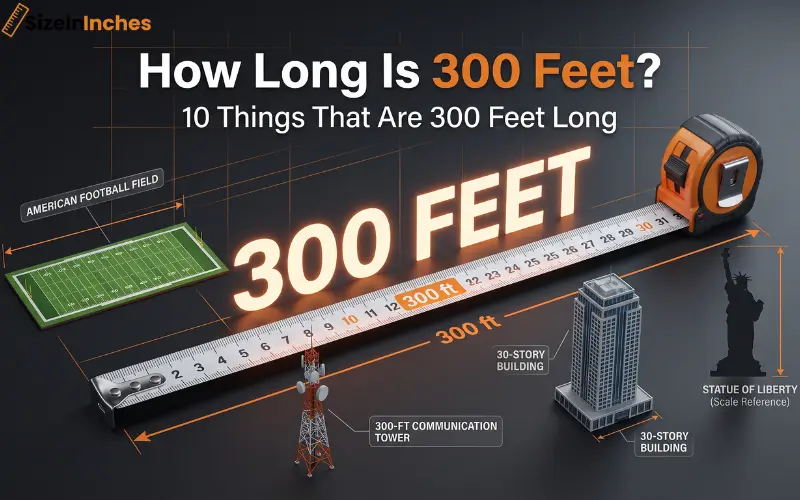
300 feet equals 3,600 inches, 9,144 centimeters, and 91.44 meters. It’s the same length as an American football field (goal line to goal line) or about 120 walking steps for an average adult.
Conversion Table
| Unit | Value |
| Feet | 300 ft |
| Inches | 3,600 |
| Centimeters | 9,144 |
| Meters | 91.44 |
| Yards | 100 |
| Millimeters | 91,440 |
Feet are used in the US, meters in most countries worldwide, and millimeters are used for engineering precision and technical drawings.
What Does 300 Feet Look Like?
Take a steady walk forward. After about 120 steps, you’ve covered roughly 300 feet. That distance feels long enough that you start noticing the separation between where you began and where you end.
Now picture a wide open field. Standing at one end and looking straight ahead, that long stretch of space gives a strong visual sense of this measurement.
At this scale, distance becomes physical. It’s no longer just seen—it’s experienced.
10 Things That Are Exactly 300 Feet Long
We have mentioned here 10 objects that will help you to understand 300 feet measurement:
1. American Football Field (Goal Line to Goal Line)
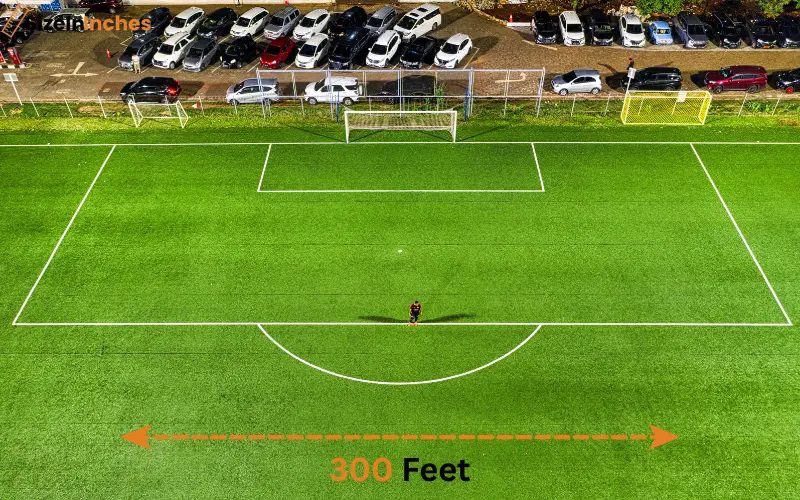
An American football field measures exactly 100 yards, which equals 300 feet, excluding the end zones. This is defined by official NFL and NCAA regulations.
You’ll see this in stadiums, school fields, and televised games across the country.
Standing at one goal line and looking toward the other creates a clear, uninterrupted visual line.
Players sprint this full distance during plays, making it feel long and demanding.
This is one of the most accurate ways to understand how long is 300 feet.
2. Three Adult Blue Whales Nose to Tail
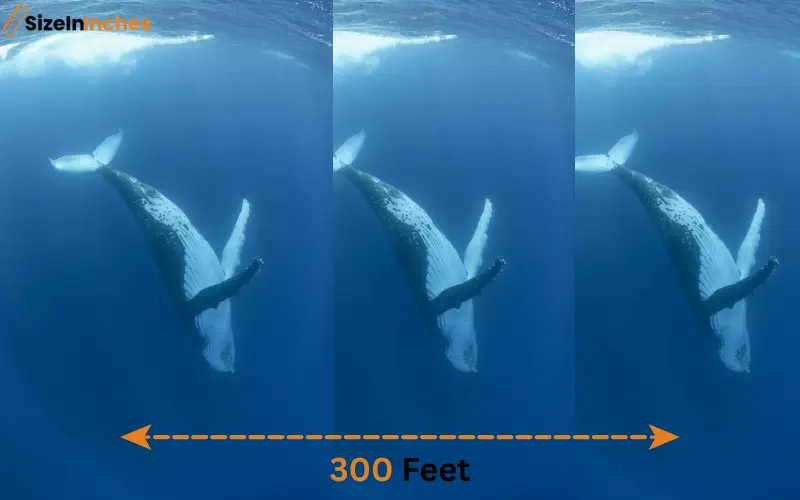
The Blue Whale reaches 100 feet in length according to NOAA marine biology data. Placing three of these whales nose to tail creates exactly 300 feet.
You would encounter these creatures in the open ocean or through life-sized exhibits in natural history museums.
Imagining three of them aligned creates a massive visual—each body stretching longer than most buildings.
The combined length forms a continuous, almost unbelievable scale.
This makes it easy to grasp how big is 300 feet using nature.
3. 300-Foot Communication Tower (FCC Registered Category)
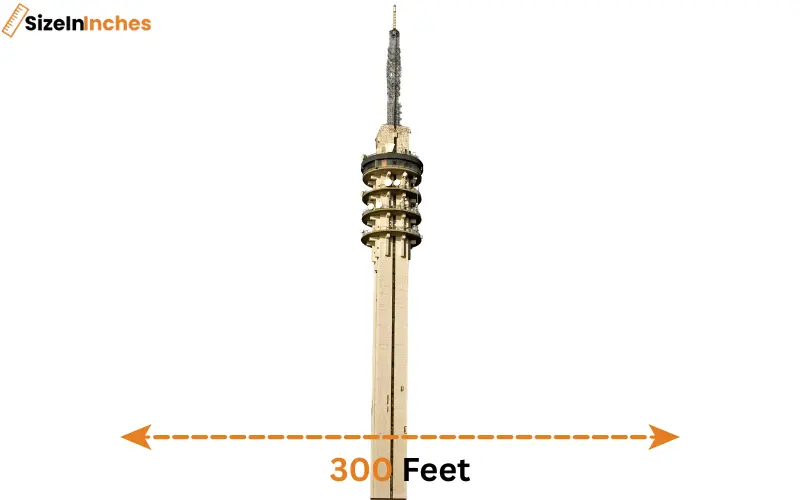
The Federal Communications Commission classifies 300 feet above ground level (AGL) as a standard tower category requiring aviation marking and lighting.
You’ll see these towers in rural landscapes, highways, and broadcasting zones.
Standing near one forces you to look straight up as it disappears into the sky.
It dominates the surrounding area visually.
This is a powerful way to understand how tall is 300 feet.
4. Niagara Falls Horseshoe Drop × 3
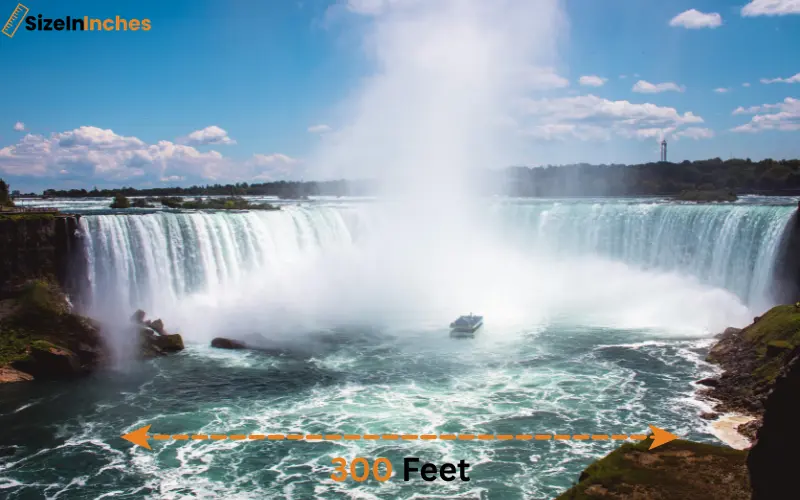
The Niagara Falls Horseshoe Falls has a vertical drop of 100 feet verified by USGS data. Stacking that drop three times equals exactly 300 feet.
You experience this at the US–Canada border where millions visit each year.
Now imagine that massive drop repeated three times upward.
The height becomes overwhelming and dramatic.
This gives a vivid vertical sense of 300 feet.
5. Six ISO Shipping Containers (50-Foot Standard Units)
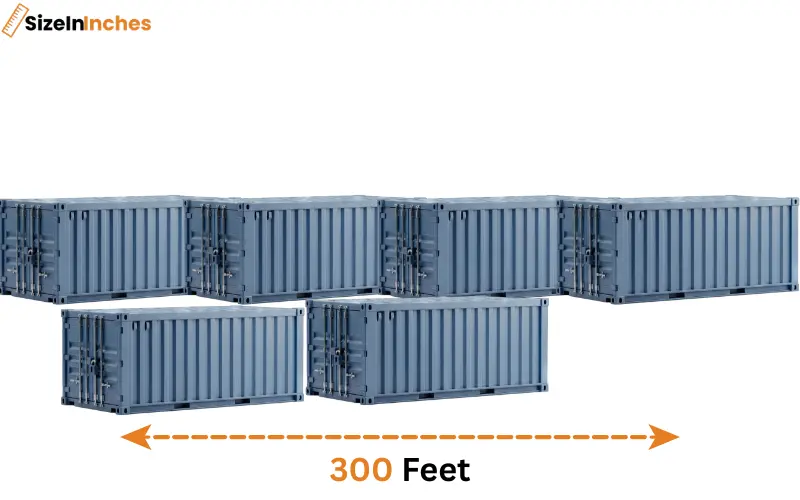
ISO 668 standards define certain container categories at 50 feet in length. Six of these placed end-to-end equal exactly 300 feet.
You’ll see these in freight yards, cargo ports, and rail transport systems.
Standing beside a line of six containers creates a long, industrial corridor of steel.
The repetition emphasizes the total length clearly.
This is a strong structural way to picture 300 ft.
6. 30-Story Building Height
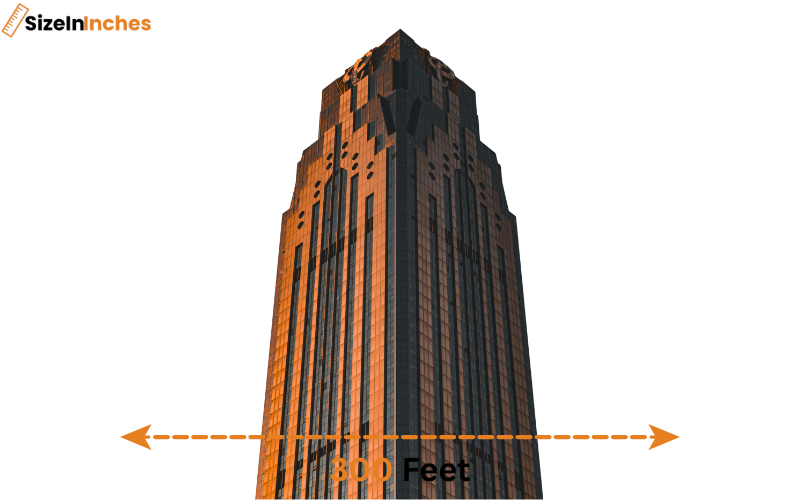
Buildings are typically designed with 10 feet per story, making 30 stories equal 300 feet.
You see structures of this height in city skylines and commercial districts.
Standing at the base, you must tilt your head fully upward to see the top.
The vertical scale feels massive and imposing.
This is one of the clearest ways to understand height.
7. Three NBA Basketball Courts End to End
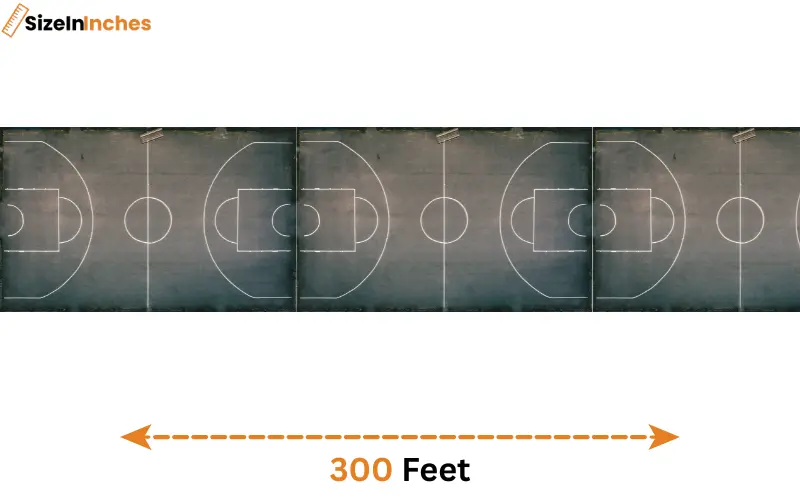
An NBA court measures 94 feet long. NBA regulations require 3 feet of out-of-bounds space on each sideline end. Three courts × 94 feet = 282 feet, plus six 3-foot end buffers = 18 feet, totaling exactly 300 feet.
You see these courts in arenas, schools, and sports complexes.
Standing at one end and looking across three courts creates a long visual corridor.
It feels like a continuous athletic stretch.
This helps visualize 300 feet in sports context.
8. Statue of Liberty (Ground to Torch)
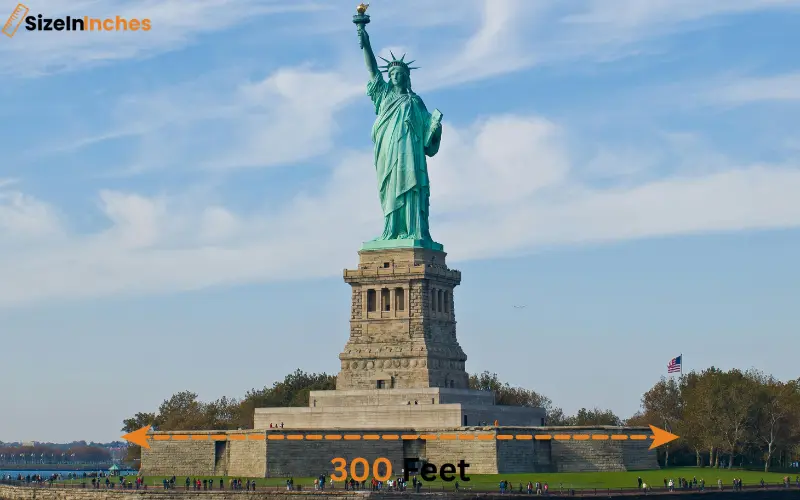
The Statue of Liberty measures 305 feet from ground to torch according to National Park Service data.
You see this landmark in New York Harbor.
Standing near it makes the height feel enormous.
At 305 feet, it stands just 5 feet above our target — making it the closest iconic American landmark you can visit to experience what 300 feet truly looks like.
This gives a near-perfect real-world comparison.
9. Seven and a Half School Buses
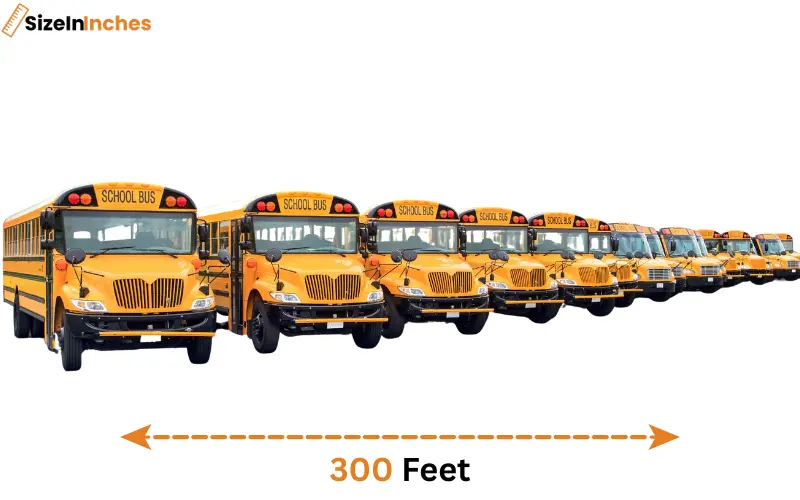
A standard school bus measures 40 feet in length under transportation specifications. Lining up 7.5 buses equals exactly 300 feet.
You see these buses in school districts and highways.
Imagining them parked nose-to-tail creates a long, continuous chain.
It stretches far beyond normal street length.
This makes it easy to understand how far is 300 feet.
10. Five Articulated City Transit Buses End to End
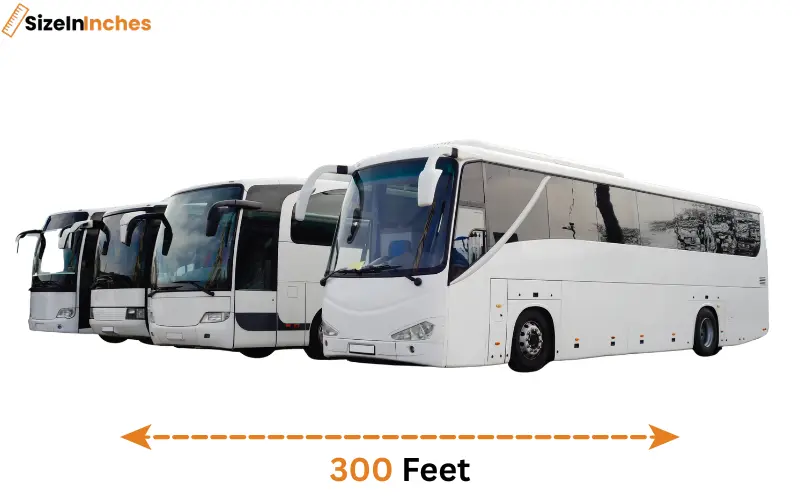
Articulated city buses such as the New Flyer XD60 are built at 60 feet in length according to manufacturer specifications. Placing five of these buses end to end creates exactly 300 feet.
You’ll see these long buses operating in major cities, especially on high-capacity transit routes.
Standing next to one already feels large, but imagining five lined up creates a powerful sense of extended distance.
The combined length forms a continuous chain that stretches far beyond a normal street view.
This makes it easy to understand how long is 300 feet using real-world vehicles.
How Big Is 300 Feet?
Indoors, 300 feet feels enormous. It could stretch across multiple connected warehouses or span an entire shopping complex floor. In such spaces, you lose the sense of one continuous area.
Outdoors, the perception changes. In open land, sports fields, or large parking zones, 300 feet becomes easier to process. It feels like a long but manageable distance.
How Tall Is 300 Feet?
Vertically, 300 feet feels massive. It matches the height of a 30-story building, which dominates most urban skylines.
Looking up at that height creates a strong sense of scale. Trees, poles, and structures below it appear small by comparison.
How Far Is 300 Feet?
Walking 300 feet takes about 120 steps based on a 2.5-foot stride length. This distance feels long enough to create separation between two points.
At a normal walking speed of 3 mph, it takes roughly 45–60 seconds to cover. It’s not instant—you feel the movement.
300 Feet Comparison Table
| Comparison | Real Example |
| 300 ft vs 250 ft | Extra 50 feet equals half a basketball court |
| 300 ft vs 350 ft | Extra 50 feet equals a semi-truck length |
| 300 ft vs 600 ft | Two football fields placed end-to-end |
Here are more Feet guides you may like:
- How long is 200 feet
- How long is 100 feet
- how long is 50 feet
- How long is 40 feet
- How long is 30 feet
- How long is 25 feet
- How long is 20 feet
How to Measure 300 Feet Without a Tape Measure
Using Your Steps
Walk naturally and count your steps. Each step is roughly 2.5 feet. To reach 300 feet, take 120 consistent steps. Keep your stride even and avoid exaggerating your movement. Use landmarks to track your start and end points.
Using Floor Tiles
Standard tiles are 1 foot wide in many spaces. Count 300 tiles in a straight line to measure the distance. Stay aligned to avoid diagonal errors. This method works best in large open areas like halls or parking zones.
Using Your Body
Your arm span is close to your height. If you are 6 feet tall, 50 full arm spans equal 300 feet. Mark each span carefully as you move forward. This method is useful when no tools are available.
FAQs
How long is 300 feet in meters?
300 feet equals 91.44 meters. This is the standard conversion used globally. It helps when comparing distances internationally.
How many steps is 300 feet?
It takes about 120 steps for most adults. Each step is roughly 2.5 feet long. Walking naturally keeps your estimate accurate.
How tall is 300 feet compared to a house?
300 feet equals a 30-story building. Most houses are 2–3 stories tall. This makes it significantly taller than residential structures.
Is 300 feet bigger than a school bus?
Yes, a school bus is 40 feet long. 300 feet equals 7.5 buses in a line. That makes it much longer.
How long does it take to walk 300 feet?
It takes about 45–60 seconds at normal walking speed. This depends on stride and pace. The distance feels noticeable when walking.
Conclusion
The three strongest visual references in this guide are the football field, the blue whales, and the Manhattan block comparison. A football field works because almost everyone has seen one, making it instantly familiar. The blue whales example creates shock value, helping your brain grasp the massive scale. The Manhattan block comparison adds a real-world urban reference that people can relate to in daily life.
Knowing this measurement becomes useful in practical situations like construction planning, property measurement, sports fields, and travel distances. Once you connect 300 feet to real objects, estimating space becomes much easier in everyday decisions. Bookmark this page so you always have a reliable mental reference whenever you need to picture how long is 300 feet.