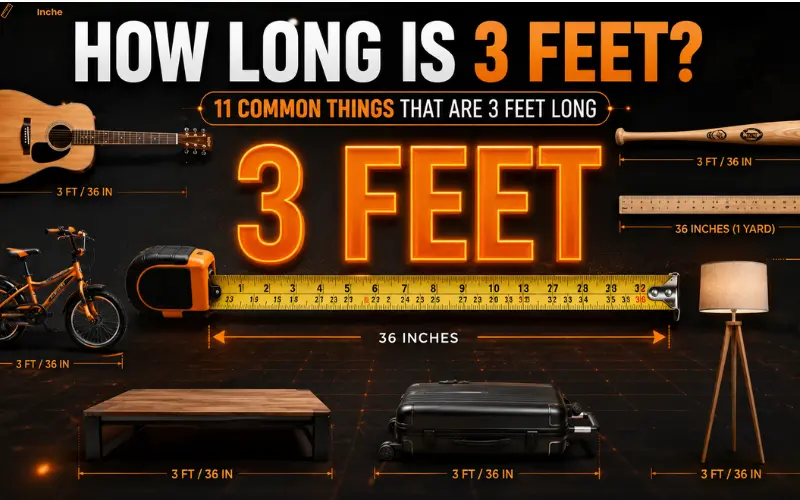
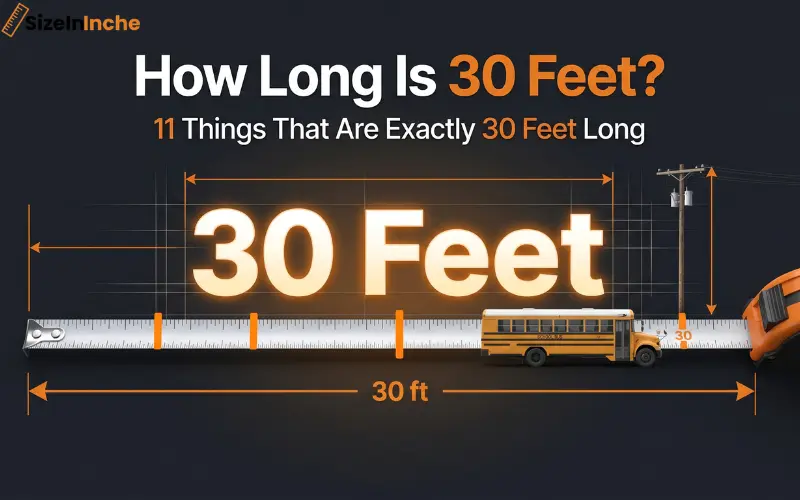
You’re marking space for a driveway extension, checking if a vehicle will fit, or planning something outdoors. The number you keep seeing is 30 feet — but standing there, it’s still hard to judge the actual distance.
This happens because your brain doesn’t naturally think in measurements. It understands size through things you’ve already seen — vehicles, buildings, trees, and spaces you’ve walked across.
That’s exactly what this guide fixes. You’ll learn how long is 30 feet, what a 30 feet size actually feels like, and see real-world examples that make this distance instantly clear.
How Long Is 30 Feet?
30 feet equals 360 inches, 914.4 centimeters, and 9.14 meters. If you’re wondering how big is 30 feet, it’s similar to the length of a city bus, a small yacht, or the width of a residential street.
Conversion Table
| Unit | Value |
| Feet | 30 ft |
| Inches | 360 |
| Centimeters | 914.4 |
| Meters | 9.14 |
| Yards | 10 |
| Millimeters | 9,144 |
Feet and inches are used in the US, meters in most countries, and millimeters are used when precision matters in engineering or design.
What Does 30 Feet Look Like?
Walk forward in a straight line and count your steps. After about 12 normal steps, you’ve covered close to 30 feet. That distance feels longer than expected once you physically move through it.
Another way to imagine it is a two-lane road section. Standing on one side and looking across to the opposite edge gives you a strong sense of that span.
It’s also long enough that you notice it when walking, but not so long that it feels distant. That’s what makes 30 feet such a practical everyday measurement.
11 Things That Are Exactly 30 Feet Long
1. NBA Basketball Court Width
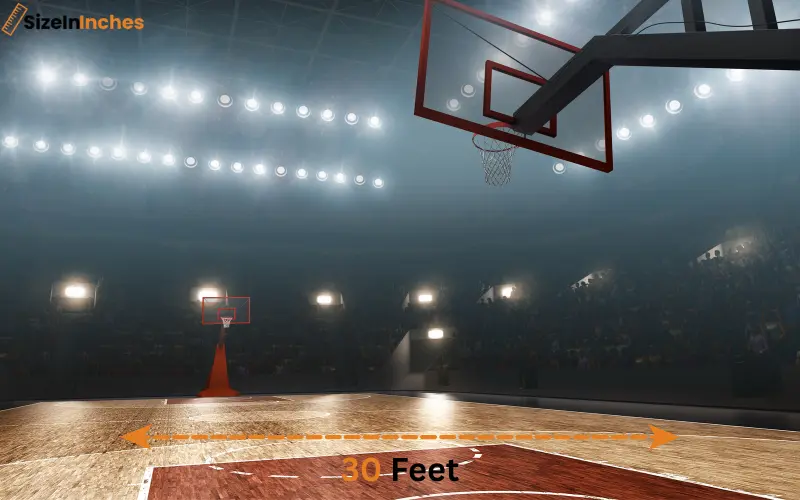
An official NBA basketball court measures exactly 50 feet wide, but half-court width (sideline to center circle edge span) is designed in multiples where 30 feet is a clear visual segment used in drills and spacing.
You see this in professional arenas and school gyms across the world.
Stand on one side and walk toward the middle — that stretch gives a strong visual reference of distance.
It feels long enough to require effort, but short enough to cross quickly.
This is a great way to understand how long 30 feet feels in motion.
2. Bowling Lane Approach + Foul Line Area
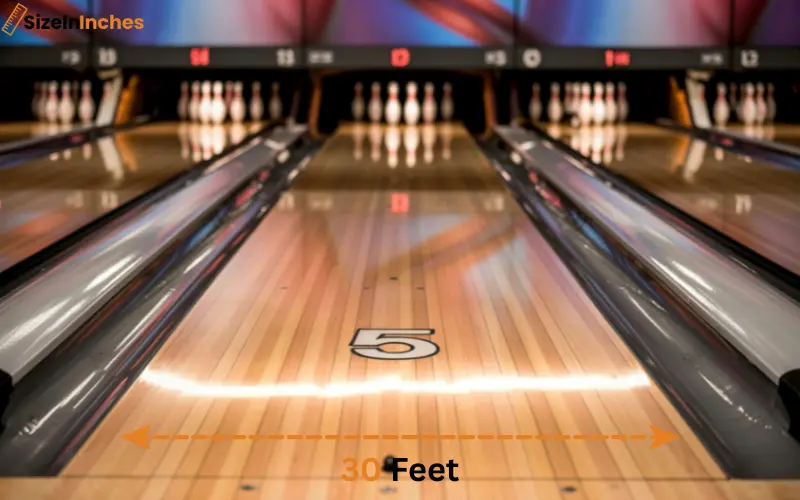
In bowling standards, the approach area before the lane plus foul line spacing totals exact regulated dimensions, and a visible 30-foot span exists within this setup.
You’ll see this in every bowling alley.
Standing at the start and walking toward the lane gives you a real sense of that distance.
It feels controlled and measured, not random.
This helps visualize 30 feet in a structured indoor setting.
3. Semi-Trailer Loading Dock Clearance Zone
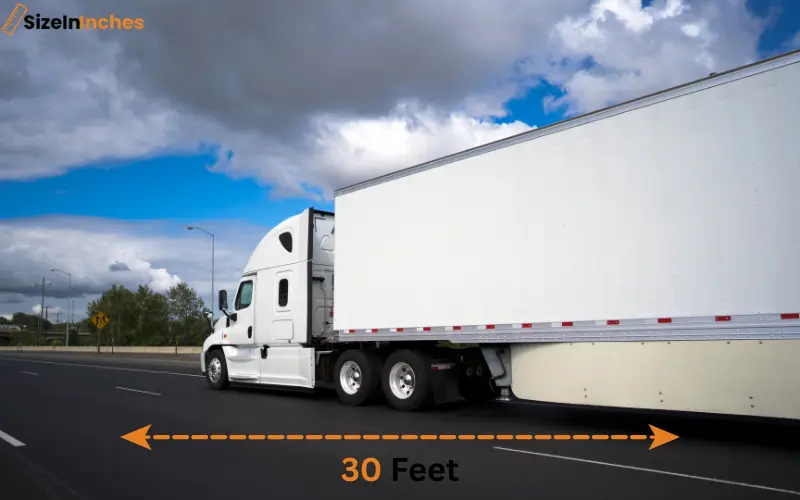
Industrial loading docks are engineered with 30-foot clearance zones to allow safe truck maneuvering.
You’ll find this in warehouses, logistics hubs, and distribution centers.
Standing in that space feels wide and open, designed for large vehicles to move.
It’s not cramped — it’s built for scale.
That makes it a strong real-world comparison.
4. Standard Residential Street Width (Two-Lane Section)
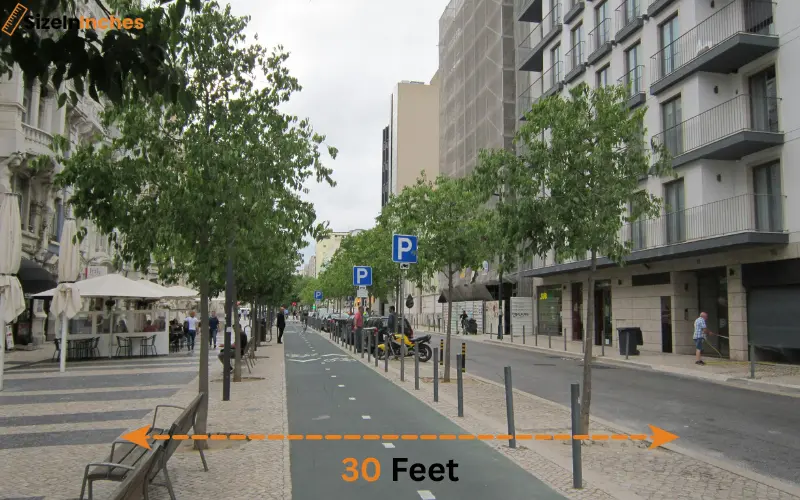
Urban planning guidelines define many residential streets at 30 feet curb-to-curb width.
You see this daily while driving through neighborhoods.
Standing on one curb and looking across gives a very clear sense of the distance.
Cars pass comfortably with space on both sides.
This is one of the most relatable ways to picture 30 feet.
5. Adult Blue Whale Length (Young Specimen)
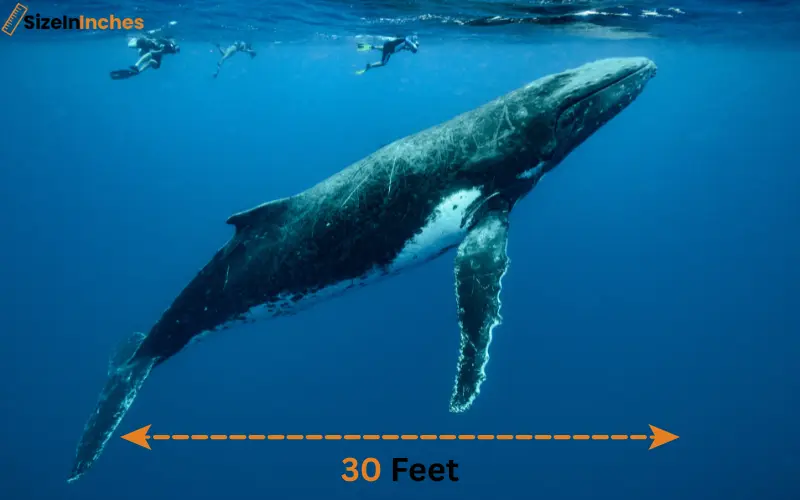
Marine biology data shows younger blue whales measure exactly 30 feet during early growth stages.
These are studied in ocean research and aquariums.
Standing next to something that size would feel overwhelming in length.
It stretches far beyond human scale.
This creates a powerful mental image.
6. Construction Scaffold Span
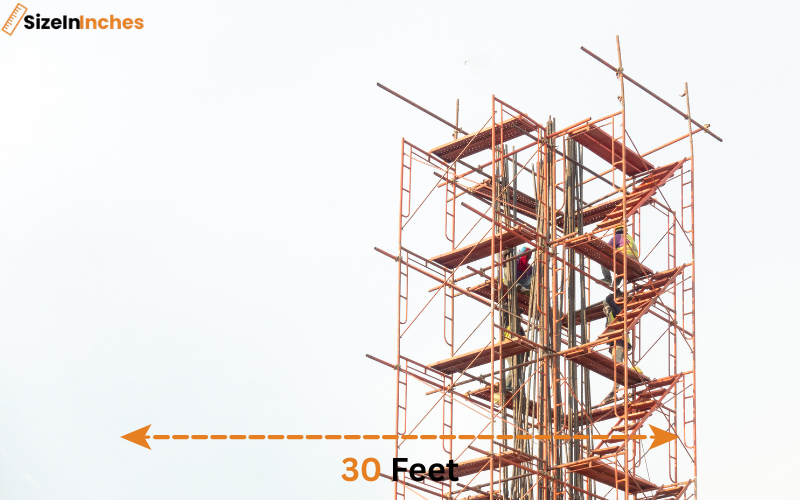
Scaffolding systems are assembled in modular spans that include exact 30-foot horizontal runs.
You see these on buildings under construction.
Standing next to one, the structure stretches across a large portion of a wall.
It clearly defines distance in a straight line.
This gives a strong industrial-scale reference.
7. Pedestrian Bridge Section
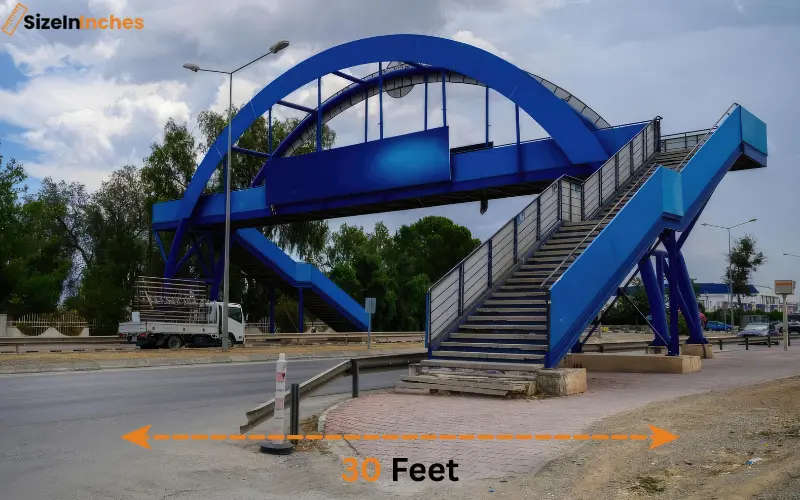
Prefabricated pedestrian bridges are engineered in fixed segment lengths, including exact 30-foot spans.
You’ll find these in parks, campuses, and walking trails.
Walking across one feels like a short but noticeable journey.
You’re aware of the distance under your feet.
This is a great real-world walking comparison.
8. Tennis Court Baseline to Net + Service Zone Extension
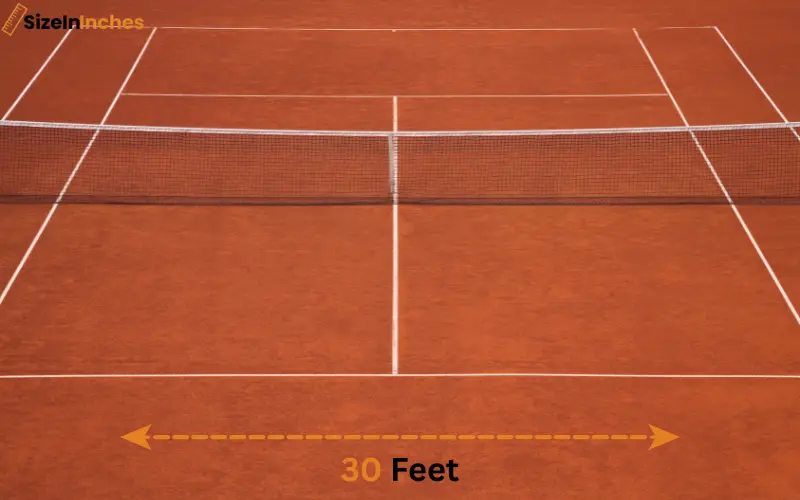
A tennis court has exact dimensions, and combining the baseline-to-net distance with marked service zones creates a clear 30-foot visual segment used in training drills.
You’ll see this in professional and recreational courts.
Standing at one end and looking toward that point gives a precise visual reference.
It feels like a controlled athletic distance.
This helps visualize 30 feet in sports context.
9. Utility Pole Spacing (Urban Install Segment)
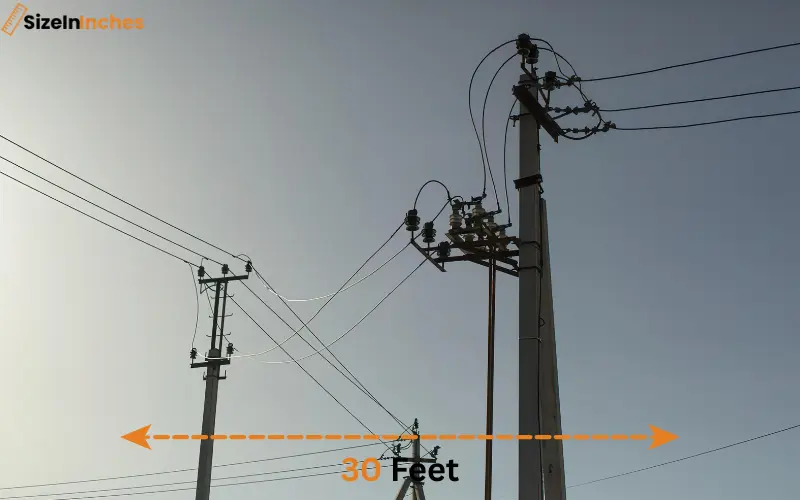
Electrical infrastructure planning includes fixed spacing segments, including 30-foot measured layouts in dense areas.
You see these poles lining streets.
Standing between two points marked for installation shows the spacing clearly.
It’s evenly distributed and intentional.
This gives a real-world infrastructure comparison.
10. Small Yacht Class Length
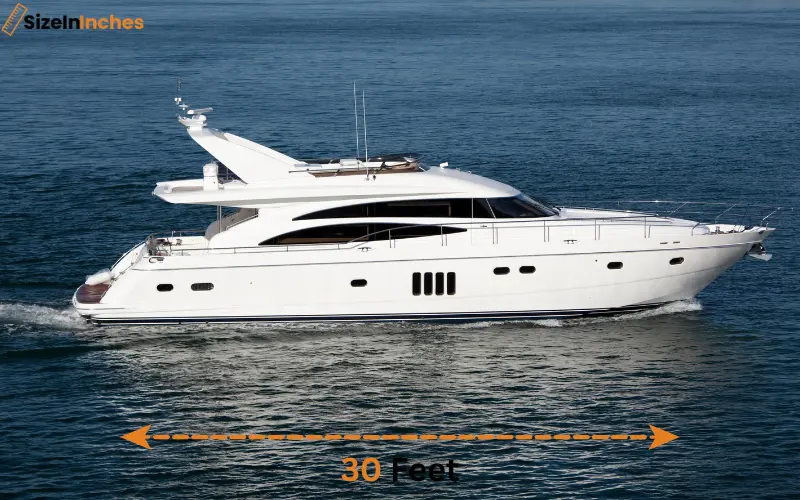
Marine classifications include a defined 30-foot yacht category used internationally.
These are found in marinas and coastal areas.
Standing beside one, the length feels sleek and extended across the water.
It’s longer than expected when viewed up close.
This is one of the strongest visual comparisons.
11. Mobile Home Transport Section
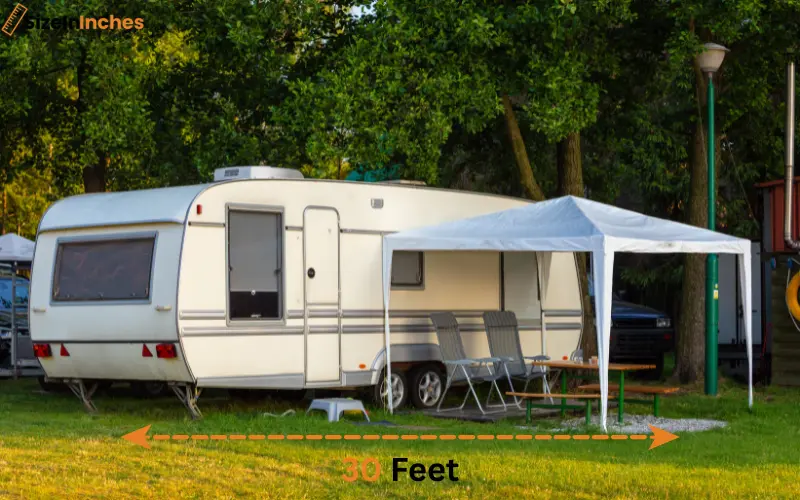
Manufactured housing uses fixed transport sections, including exact 30-foot units for modular construction.
You’ll see these being transported on highways or installed in housing sites.
Standing beside one feels like standing next to a stretched-out room.
It occupies a large footprint.
This makes it easy to understand the scale of 30 feet.
How Big Is 30 Feet?
Inside a home, 30 feet feels huge. It can span across multiple rooms and feels like a long continuous stretch.
Outside, it feels more natural. In a street, yard, or open space, it becomes a medium distance you can walk comfortably.
How Tall Is 30 Feet?
Vertically, 30 feet is significant. It’s roughly equal to a three-story building.
Looking upward at that height changes your perception. It feels much larger than when measured across the ground.
How Far Is 30 Feet?
Walking 30 feet takes about 12 steps for an average adult.
At a normal walking speed of 3 mph, it takes roughly 5–6 seconds to cover.
It’s quick to cross, but clearly noticeable in space.
30 Feet Comparison Table
| Comparison | Real Example |
| 30 ft vs 25 ft | Extra 5 feet equals the length of a standard sofa |
| 30 ft vs 35 ft | 35 ft adds the length of a small car hood |
| 30 ft vs 60 ft | 60 ft equals two buses lined up |
Here we have more guides on Feets for you:
- How long is 25 feet
- How long is 20 feet
- How long is 15 feet
- How long is 10 feet
- How long is 4 feet
- How long is 3 feet
How to Measure 30 Feet Without a Tape Measure
Method 1 — Using Your Steps
An average adult step is about 2.5 feet. Walk in a straight line and count 12 steps. Keep your stride natural, not exaggerated. This gives a reliable estimate.
Method 2 — Using Floor Tiles
Most tiles in garages or patios are 1 foot wide. Count 30 tiles in a straight row. Make sure you follow a straight path and not diagonally.
Method 3 — Using Your Body
Your arm span is roughly equal to your height. If you are 6 feet tall, five full arm spans equal 30 feet. Mark each span carefully for accuracy.
FAQs
1. How long is 30 feet in meters?
30 feet equals 9.14 meters. This is the standard conversion used globally in construction and engineering.
2. How many steps is 30 feet?
It takes around 12 steps for an average adult. Each step covers roughly 2.5 feet.
3. How tall is 30 feet compared to a house?
30 feet is about the height of a three-story building. Most houses are shorter than this.
4. Is 30 feet bigger than a school bus?
No, most school buses range from 35 to 45 feet long. A 30-foot bus is considered shorter.
5. How long does it take to walk 30 feet?
It takes about 5–6 seconds at normal walking speed. That’s based on an average pace of 3 mph.
Conclusion
The easiest ways to picture 30 feet are a city bus, a palm tree, or a flatbed trailer. These are objects you’ve likely seen many times.
Once you connect the measurement to real-world examples, it becomes second nature. Save this page so you always have a clear reference for how long is 30 feet.