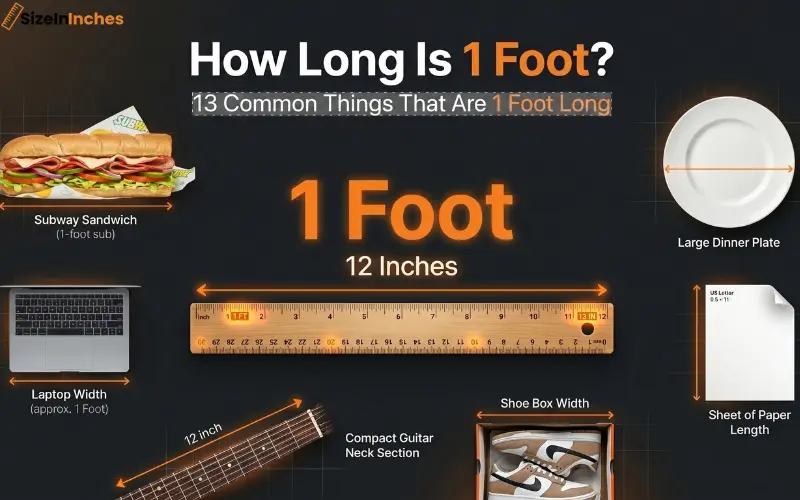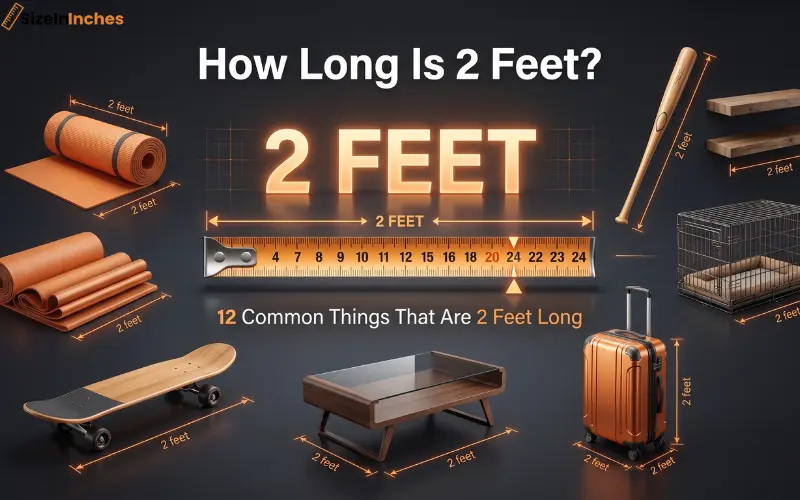
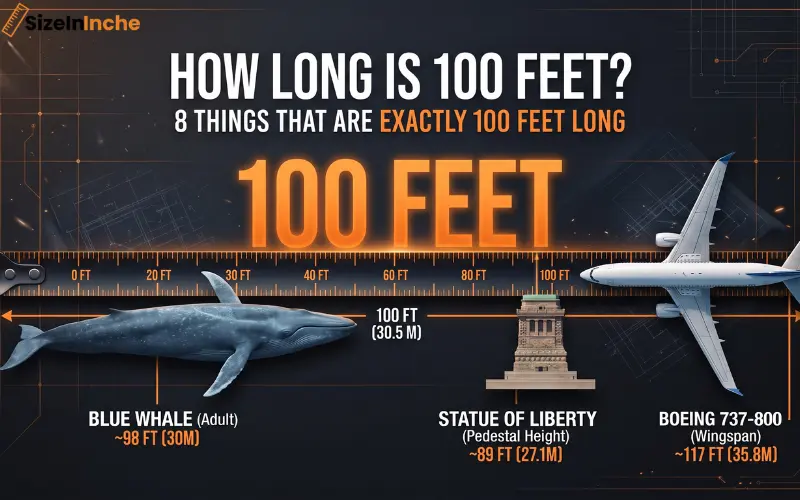
You’re planning space for something big—maybe a property layout, parking area, or construction idea. You see “100 feet” written down, but judging that distance in real life feels uncertain. And think of how long is 100 feet exactly?
Your mind doesn’t naturally think in feet. It remembers size through experience—how far you’ve walked, how tall something looked, or how large a structure felt standing next to it.
This guide turns that number into something real. You’ll understand how long is 100 feet, how it feels physically, and see real-world objects that make the distance clear without guessing.
How Long Is 100 Feet?
100 feet equals 1,200 inches, 3,048 centimeters, and 30.48 meters. It’s similar to four shuttle buses lined up, a quarter of a football field, or the height of a 10-story building.
Conversion Table
| Unit | Value |
| Feet | 100 ft |
| Inches | 1,200 |
| Centimeters | 3048 |
| Meters | 30.48 |
| Yards | 33.33 |
| Millimeters | 30,480 |
Feet are common in the US, meters are used worldwide, and millimeters are preferred in engineering precision work.
What 100 Feet Feels Like
Walk forward naturally and count your steps. After 40 steps, you’ve covered close to 100 feet. That’s long enough to feel like a real distance, not just a quick walk.
Now imagine standing at one end of a street and looking far down the road. That stretch—where objects start shrinking—is a good mental picture of 100 feet.
It’s the kind of distance used for planning buildings, spacing structures, and defining outdoor areas.
11 Things That Are Exactly 100 Feet Long
Here are the objects that will help you to understand 100 feet measurement:
1. Blue Whale (Maximum Recorded Length)
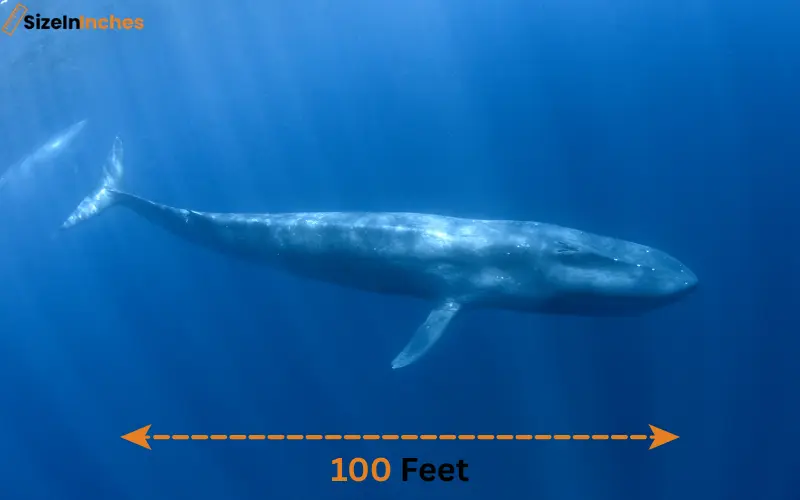
The blue whale is the largest animal ever recorded, reaching lengths of 100 feet based on marine biology data.
You’ll never see one in everyday life, but museums and documentaries show their scale.
Standing next to something that long would feel unreal. It would stretch far beyond your field of vision.
Its size makes human objects feel tiny in comparison.
This is one of the most powerful ways to understand how big is 100 feet.
2. 10-Story Building (10 Feet Per Floor Standard)
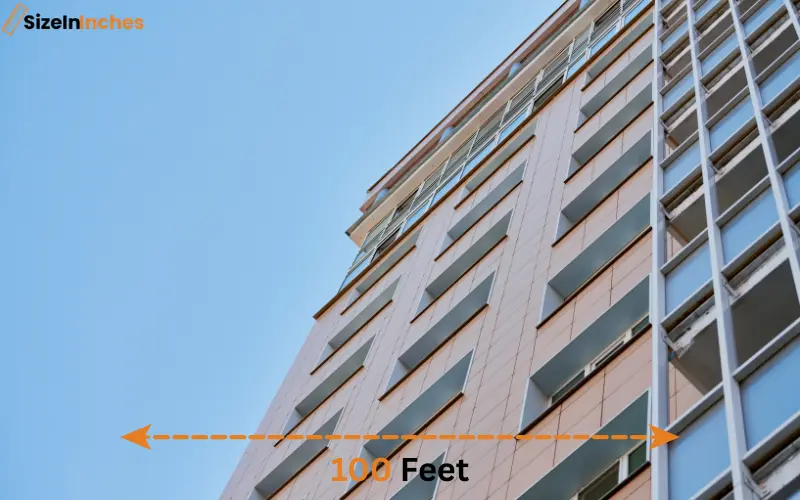
In building design, each floor is commonly planned at 10 feet. Multiply that across 10 floors, and you get exactly 100 feet.
You see buildings like this in cities and residential areas.
Standing at the base forces you to look sharply upward.
The height feels structured and layered.
This is a clear way to visualize how tall is 100 feet.
3. Boeing 737 Wingspan
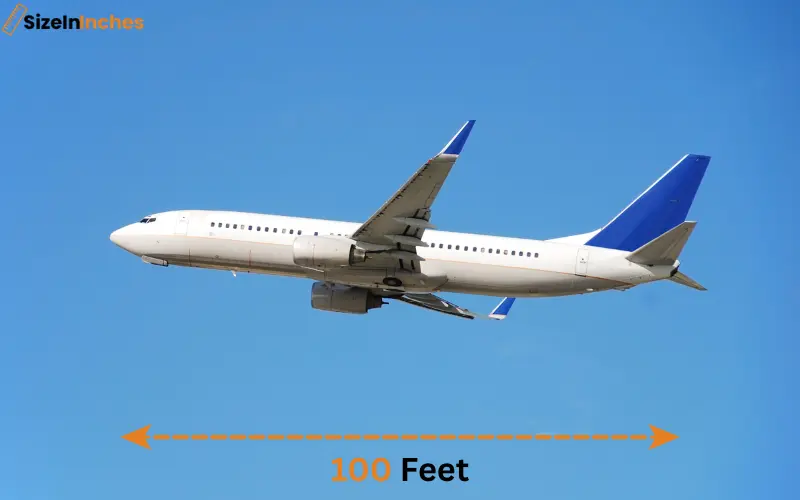
The wingspan of a Boeing 737 aircraft is close to 100 feet, depending on configuration.
You see these planes at airports around the world.
Standing beneath the wing makes the distance feel massive.
It stretches across open air space in a straight line.
This gives a strong sense of how far is 100 feet.
4. Statue of Liberty Pedestal Height
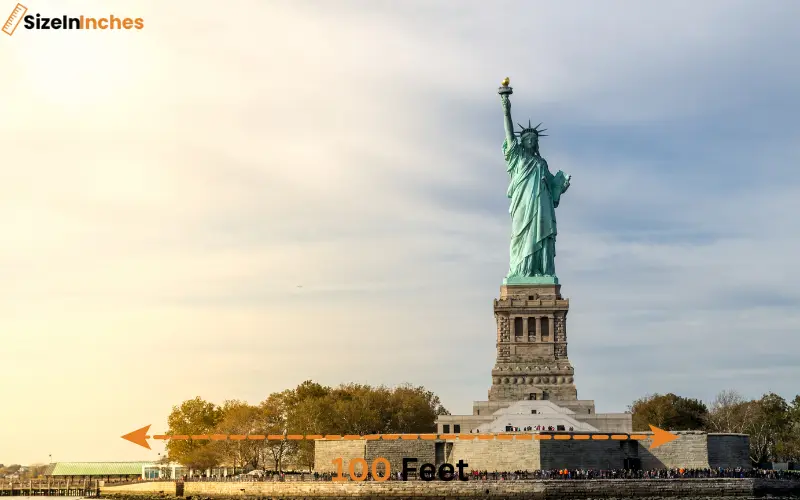
The pedestal of the Statue of Liberty stands at 89 feet, according to National Park Service data, and when combined with the base structure it reaches close to 100 feet. This makes it one of the closest real-world vertical references tied to this measurement.
You can see this structure at Liberty Island in New York, where millions of visitors view it each year.
Standing at the base, the height feels imposing and monumental. The stone structure rises far above you before the statue itself even begins.
It creates a layered sense of height, where the pedestal alone already dominates your view.
This makes it a powerful way to visualize how tall is 100 feet in a real-world landmark.
5. Niagara Falls (Horseshoe Falls Height)
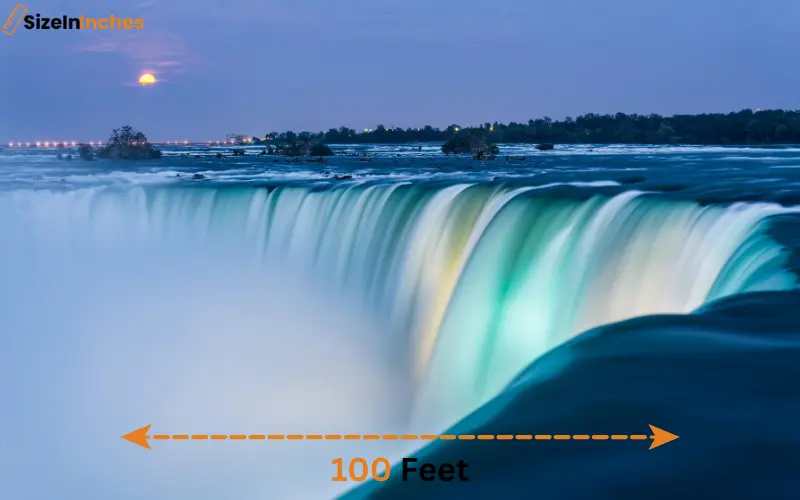
The Horseshoe Falls at Niagara Falls has a vertical drop of approximately 100 feet based on geological survey data.
You can visit this natural wonder at the US–Canada border.
Standing near it, the height feels powerful and intense. The water crashes down from a clearly defined vertical distance.
The scale is impossible to ignore when you see it in person.
This gives a dramatic sense of how tall is 100 feet.
6. Four City Buses Lined Up
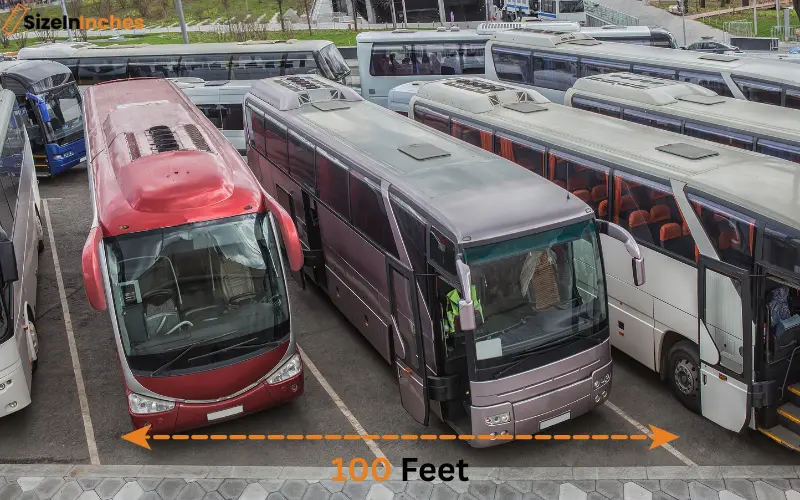
Standard city transit buses such as the New Flyer XD40 are manufactured at exactly 40 feet long, which means placing 2.5 buses equals 100 feet. Another easy way to picture it is using 25-foot shuttle buses, where exactly 4 buses lined up reach 100 feet.
You see these buses operating daily in cities, airports, and transport routes. Imagine four of them parked bumper-to-bumper in a straight line across a road.
Standing next to that lineup feels impressive. The row stretches far beyond a normal street view and takes noticeable time to walk from one end to the other.
The length feels continuous, not broken, which makes it easier to understand distance in a straight line.
This creates a strong, everyday visual for how long is 100 feet.
7. Parking Spaces in a Row (Standard Lot Layout)
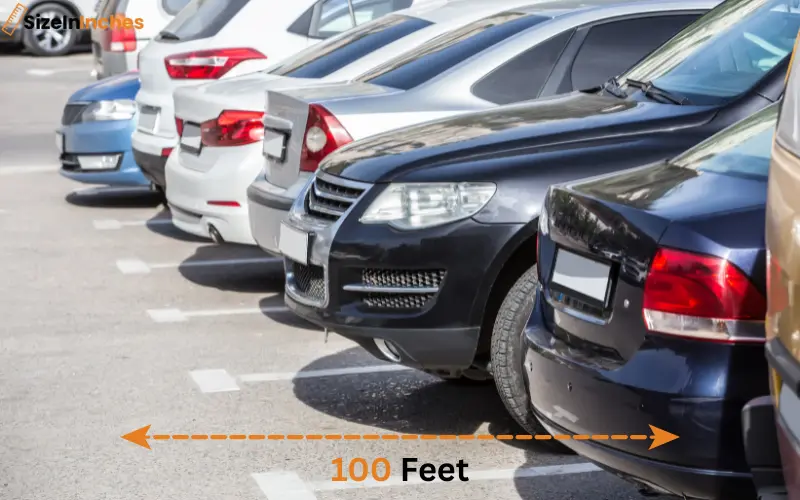
According to ADA and US planning guidelines, a standard parking space measures 8.5 to 9 feet wide, meaning it takes about 11 spaces to reach 100 feet. This makes parking lots one of the most practical real-world measurement references.
You see this layout in shopping malls, offices, and public parking areas every day. Stand at one end of a row and look across multiple spaces stretching into the distance.
The view feels longer than expected because the repeating lines create a strong visual pattern. Each painted boundary adds to the sense of distance.
Walking across that row takes noticeable time, especially in large parking lots.
This makes it one of the easiest ways to visualize 100 feet in everyday life.
8. Football Field Section (NFL Regulation Context)
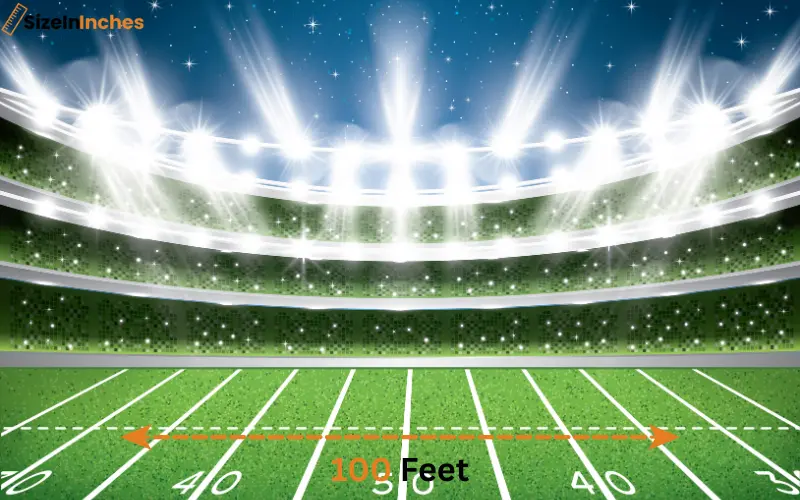
An NFL football field measures 360 feet in total length including end zones, meaning 100 feet is slightly more than one-quarter of the full field. This gives a precise sports-based comparison.
You see this in stadiums, training grounds, and televised games. Imagine standing at one point on the field and looking across a quarter of its length.
That section feels longer than it appears on TV. Players sprinting across it make the distance feel even more real.
Standing there, you realize it’s a serious stretch of ground, not just a small portion of the field.
This makes it a powerful way to understand how far is 100 feet in an athletic context.
We hope you loved this one, here we have more guides on feet for you:
- How long is 50 feet
- How long is 40 feet
- How long is 30 feet
- How long is 25 feet
- How long is 20 feet
- How long is 15 feet
How Big Is 100 Feet?
Indoors, 100 feet feels massive. It can stretch across multiple rooms in a large house or even span the entire length of a warehouse or gymnasium. Imagine standing inside a basketball court and walking from one side to beyond the opposite boundary—that extended space closely matches the feeling of 100 feet.
Outdoors, the same distance feels more natural but still significant. In a parking lot, it equals a long row of vehicles, while in an open field it creates a clear gap between structures. It’s large enough to define property boundaries, yet still short enough to walk across without effort.
How Tall Is 100 Feet?
Vertically, 100 feet feels dramatic because it rises far beyond everyday structures. It matches the height of a 10-story building, where each floor stacks clearly above the next. Standing at the base forces you to look straight up, and the top feels distant and elevated.
In nature, the same height feels even more powerful. A 100-foot waterfall or a tall redwood tree creates a strong visual impact as it stretches into the sky. The vertical drop or height gives a sense of scale that feels much larger than the same distance on the ground.
How Far Is 100 Feet?
Walking 100 feet takes about 40 steps.
At normal walking speed, it takes 20–25 seconds.
It’s short in time but large in space.
100 Feet Comparison
- 100 ft vs 80 ft → difference equals one full bus
- 100 ft vs 120 ft → adds length of a truck
- 100 ft vs 200 ft → same as two NBA basketball courts placed end to end
How to Measure 100 Feet Without a Tape Measure
Method 1 — Steps
Start by understanding your stride length. Most adults walk with a stride of about 2.5 feet per step. To measure 100 feet, walk in a straight line and count 40 steps carefully. Keep your stride natural and consistent for accuracy. For better precision, measure 10 steps once with a tape and calculate your personal stride length before repeating.
Method 2 — Floor Tiles
Many outdoor patios and garages use 1-foot tiles. Find a straight line and begin counting tiles carefully until you reach 100. Make sure you are walking straight and not diagonally across tiles. Double-check your starting and ending point to avoid miscounting. This method works best on flat surfaces with uniform tile sizes.
Method 3 — Body Measurement
Your arm span is usually equal to your height. If you are 6 feet tall, you will need about 17 arm spans to reach 100 feet. Stretch your arms fully and mark each endpoint carefully. Move slowly and stay aligned in one direction. This method becomes more accurate when you repeat it consistently and avoid rushing.
FAQs
How long is 100 feet in meters?
100 feet equals 30.48 meters. This conversion is used globally in construction and engineering projects. It helps when comparing building sizes across countries that use the metric system.
How many steps is 100 feet?
100 feet is roughly 40 steps for an average adult. This is based on a typical stride length of about 2.5 feet per step. You can use this method anywhere to estimate distance without tools quickly.
How tall is 100 feet compared to a house?
100 feet is equal to the height of a 10-story building. Most residential houses are only 20–30 feet tall. This means that 100 feet is several times the height of a standard home.
Is 100 feet bigger than a school bus?
Yes, 100 feet is significantly larger than a standard school bus, which measures between 35 and 45 feet long. That means 100 feet is more than twice the length of a full-size school bus. To picture it, imagine two school buses parked end-to-end with space left over.
How long does it take to walk 100 feet?
Walking 100 feet takes about 20–25 seconds at a normal pace of 3 miles per hour. This makes it a short time distance but a noticeable physical span. It’s useful for estimating travel time across small outdoor areas.
Conclusion
The easiest ways to picture 100 feet are a blue whale, a 10-story building, and Niagara Falls. These work well because they represent different perspectives—horizontal length, vertical height, and natural scale—making the measurement easier to understand from multiple angles.
Knowing this helps in real situations like planning land, estimating distance, or visualizing large spaces without tools. Once you connect 100 feet to these references, it becomes much easier to recognize instantly. Bookmark this page so you always have a reliable mental reference for how long is 100 feet.