Think about standing at one end of a quiet street or a large parking area. There’s a stretch of space ahead of you — not huge, but definitely not small either. That’s the kind of distance we’re talking about when we say how long is 50 feet.
Most people don’t struggle with numbers — they struggle with visualizing them. Saying “50 feet” doesn’t create a clear picture unless you connect it to something real.
This guide does exactly that. You’ll learn how long is 50 feet, what it feels like in real space, and see things that are 50 feet so you can recognize this distance instantly.
How Long Is 50 Feet?
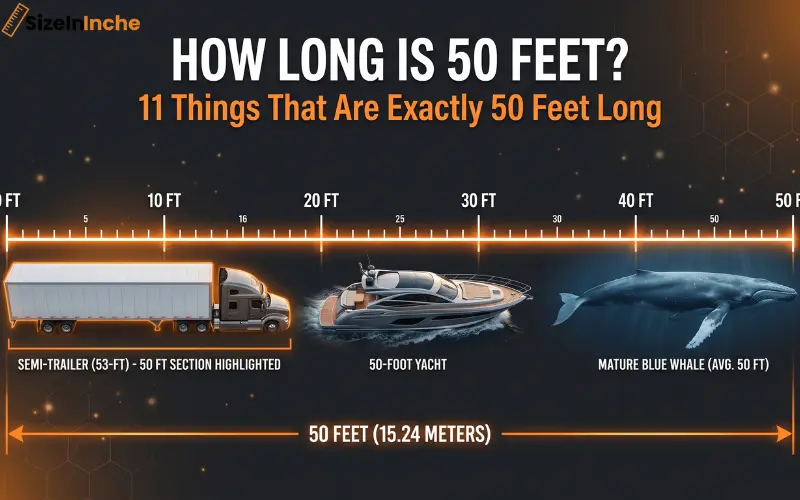
50 feet equals 600 inches, 1,524 centimeters, and 15.24 meters. It’s similar to the width of a basketball court or longer than a school bus.
The Exact Length of 50 Feet
Here’s the precise breakdown:
- 50 feet = 600 inches
- 50 feet = 1,524 centimeters
- 50 feet = 15.24 meters
- 50 feet = 16.67 yards
- 50 feet = 15,240 millimeters
This is the technical side. But understanding comes from real-world comparison.
Try This: Walk the Distance Yourself
Start walking at your normal pace.
Count your steps. By the time you reach 20 steps, you’ve covered very close to 50 feet. Now turn around and look back.
That stretch feels real now. It’s long enough to separate spaces, park large vehicles, or define boundaries.
This is what how far is 50 feet actually feels like.
Real Objects That Show You What 50 Feet Looks Like
Instead of trying to imagine numbers, it’s much easier to understand 50 feet by comparing it to things you’ve actually seen in real life. Objects like vehicles, buildings, and natural structures give your brain a clear reference point, making the distance feel real instead of abstract.
When you connect 50 feet to familiar surroundings, it instantly becomes easier to judge space, plan layouts, and understand scale without needing a measuring tape.
1. Semi-Truck Trailer (Standard Freight Length)
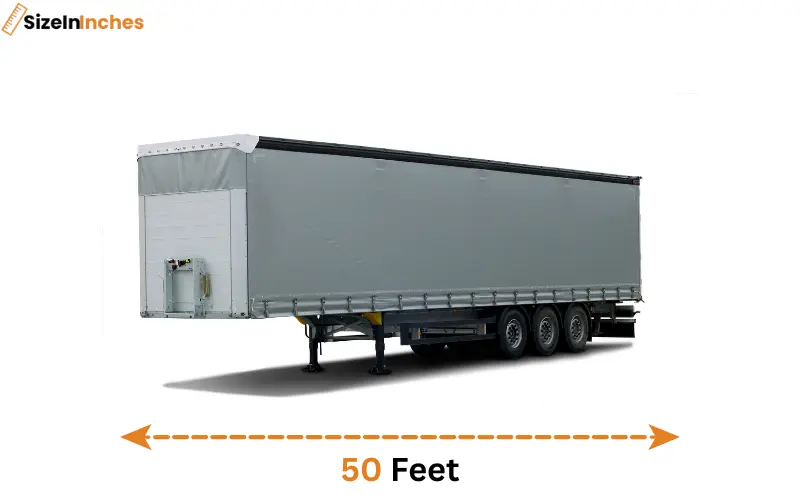
The most common freight trailer used in logistics measures 48 to 53 feet, with 50 feet falling directly within this real-world range used across transport systems.
You see these trucks daily on highways carrying goods across cities.
Standing beside one feels overwhelming. It stretches far beyond a normal vehicle and dominates the lane.
The length continues as you walk alongside it, making the distance feel very real.
This is one of the strongest ways to understand how long is 50 feet.
2. Basketball Court Width (NBA Standard 50 Feet)
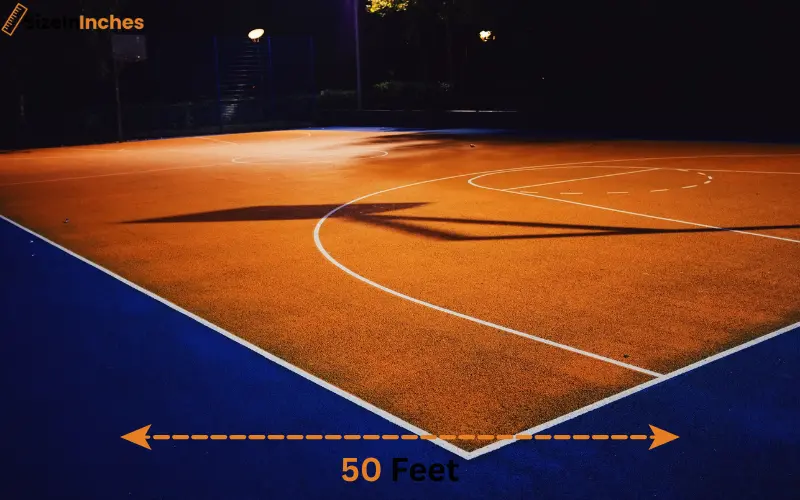
An NBA basketball court has an exact 50-foot width, defined by official league rules.
You’ve seen this countless times in games or school gyms.
Stand on one sideline and look straight across to the other — that’s exactly 50 feet.
It feels wide, open, and structured for movement.
This is one of the clearest ways to visualize 50 feet size.
3. Large Sailboat Length (50-Foot Class)
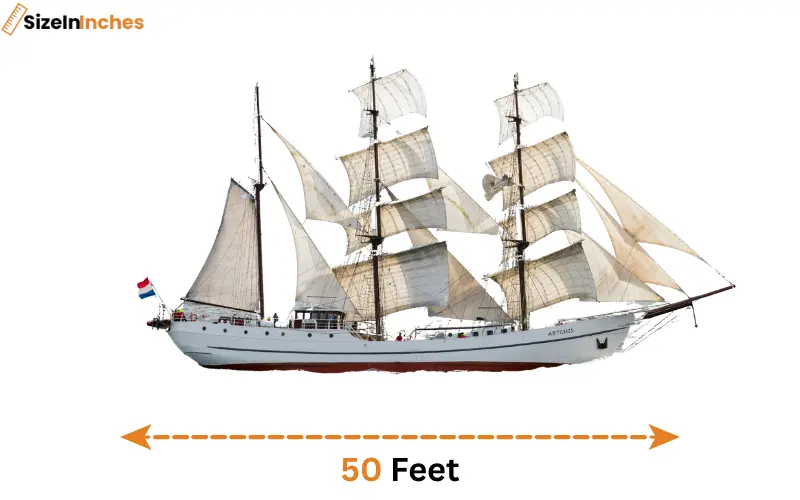
Boat classifications include a 50-foot sailing yacht category, used for long-distance travel and luxury cruising.
These are commonly seen in marinas and coastal areas.
Standing next to one shows a long, elegant structure stretching across the water.
It feels extended and powerful.
This gives a strong sense of how big is 50 feet.
4. Blue Whale (Young Specimen Length)
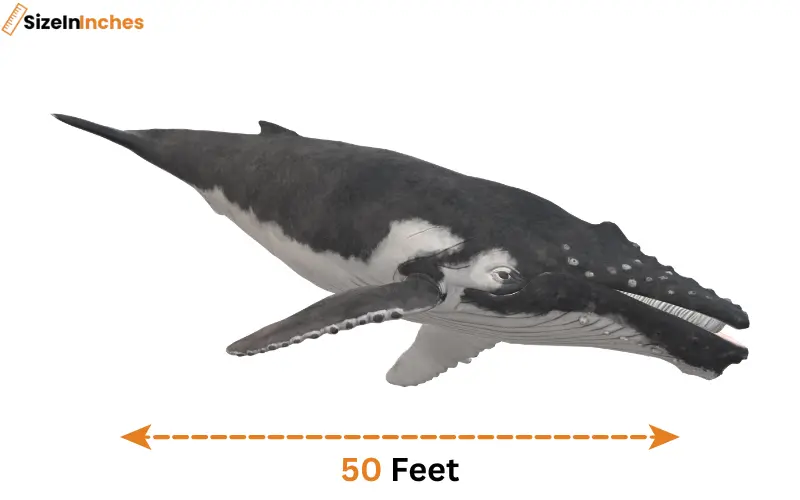
Young blue whales can measure 50 feet during early growth stages, according to marine biology records.
These are the largest animals on Earth.
Imagining one this size gives a powerful sense of scale.
It stretches far beyond anything you see daily.
This creates one of the most dramatic mental images of 50 feet.
5. Five-Story Building Height
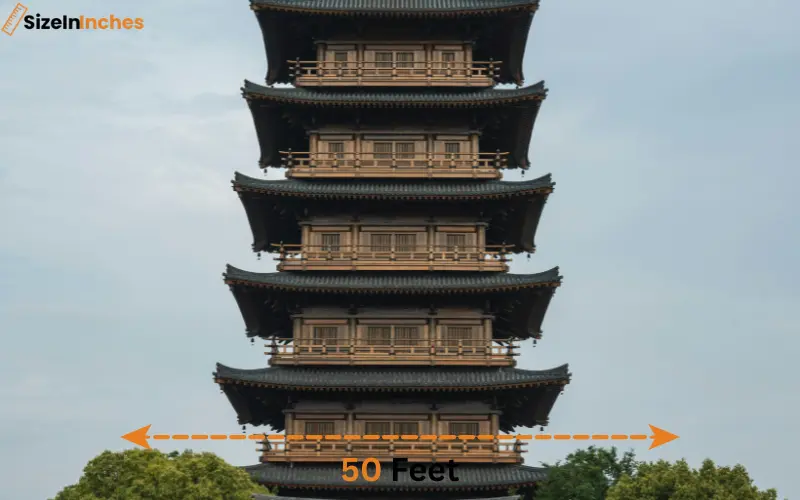
A typical building story is about 10 feet tall. Multiply that by five, and you get 50 feet.
You see buildings like this in cities and residential complexes.
Looking up at one makes the height feel significant.
It’s tall enough to dominate your field of view.
This helps answer how tall is 50 feet.
6. Utility Pole Span Across Street
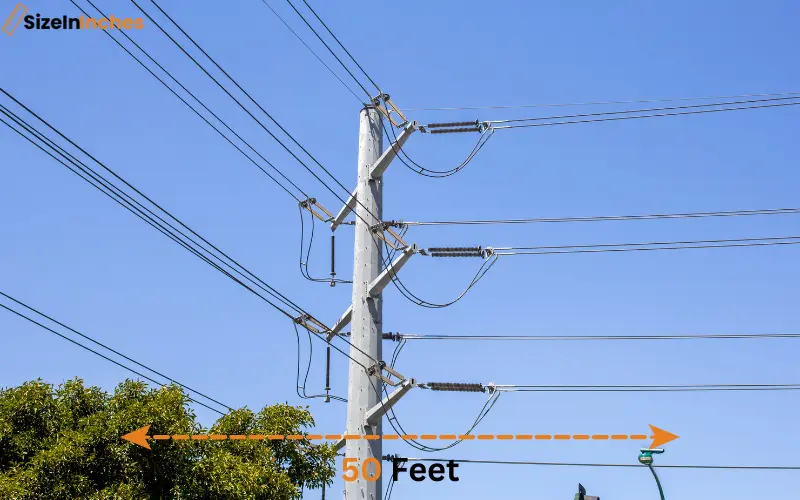
In infrastructure design, the span between certain poles across wide streets can reach 50 feet, depending on layout standards.
You’ll notice this in larger roads and intersections.
Standing under that space gives a sense of openness.
It’s wide enough for vehicles to move freely.
This shows how 50 feet works in real environments.
7. Olympic Swimming Pool Half-Length
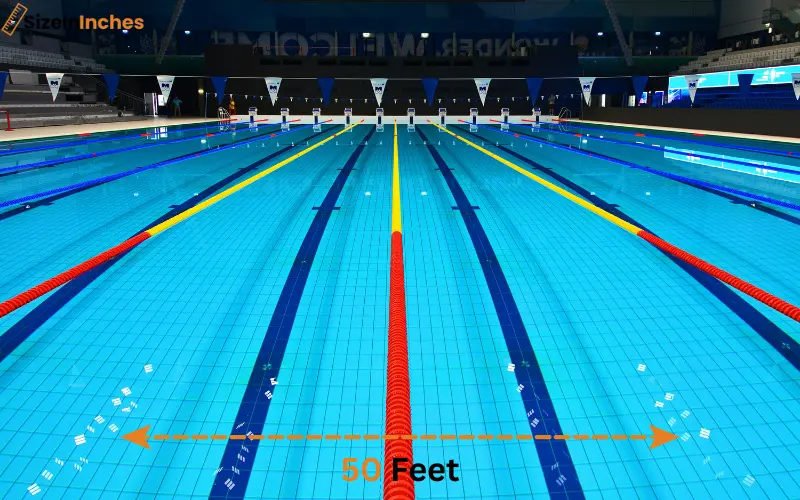
An Olympic pool is 50 meters long, but half its width and key training distances include clear 50-foot segments used in drills.
You see this in competitive swimming environments.
Swimming that distance feels controlled but demanding.
It’s long enough to challenge movement.
This gives a physical sense of 50 feet.
8. Large Tree Height (Urban Shade Tree)
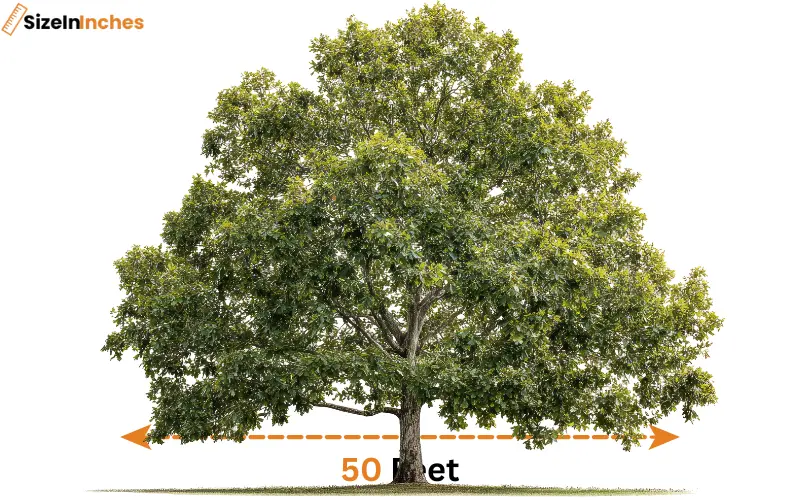
Urban trees like oak or maple can reach 50 feet in height when mature.
You see these lining streets and parks.
Standing beneath one makes you look straight upward.
It creates a strong vertical impression.
This helps visualize how tall is 50 feet.
9. Industrial Warehouse Bay Width
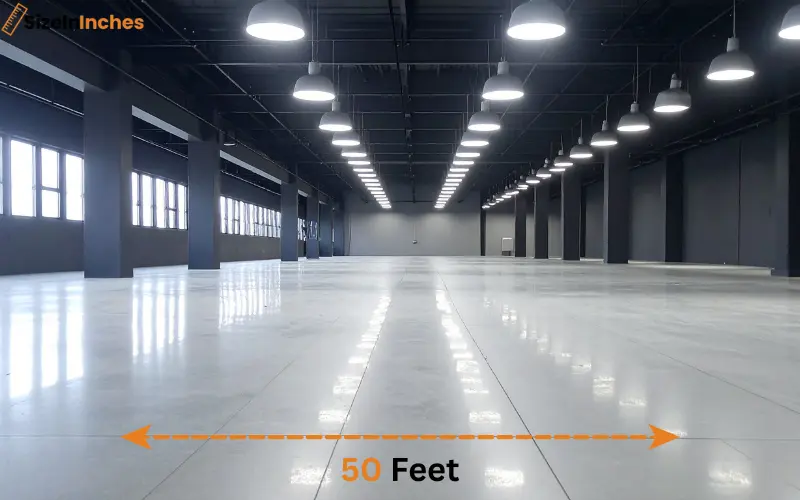
Warehouse design includes 50-foot bay spacing for structural layout and equipment movement.
You see this in large storage and logistics centers.
Standing in that space feels open and functional.
It’s wide enough for machinery to operate comfortably.
This is a practical 50 feet comparison.
10. Highway Lane Cluster (Multiple Lane Span)
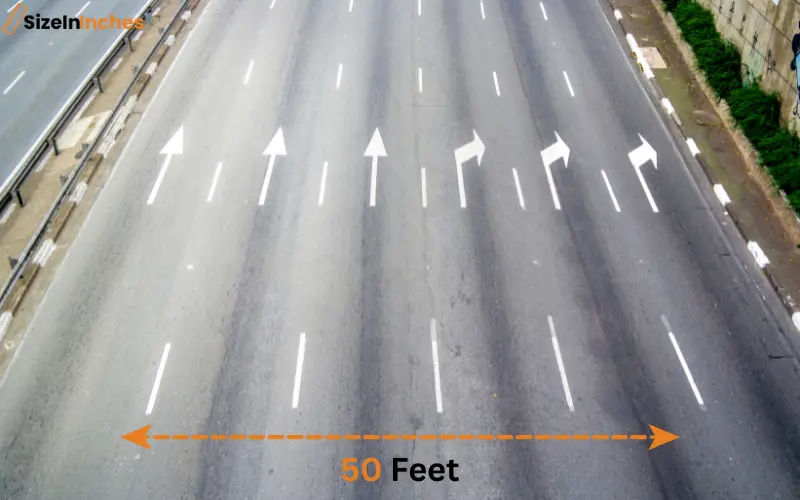
A multi-lane highway section including shoulders can stretch close to 50 feet across.
You experience this while driving.
Looking across that width gives a sense of distance between edges.
It feels large but still manageable.
This shows how far is 50 feet in daily life.
11. Bridge Segment (Precast Structural Unit)
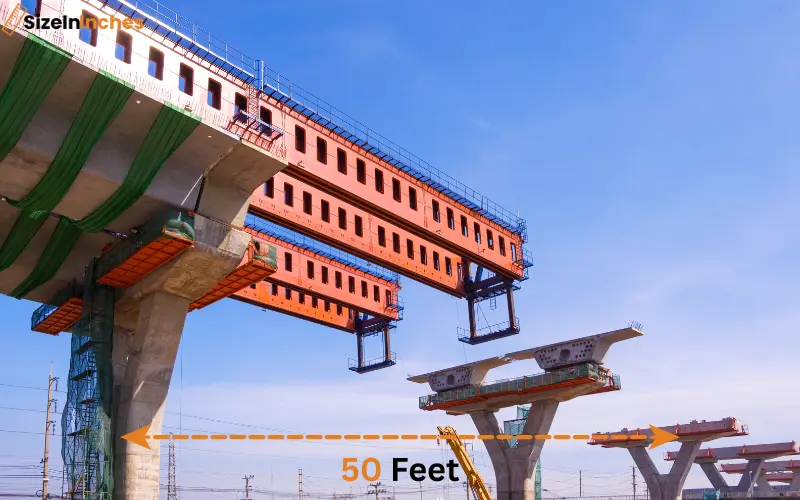
Bridge construction often uses 50-foot precast segments for efficient installation.
You’ll see these in road and infrastructure projects.
Standing next to one shows a long, rigid structure.
It defines space with precision.
This helps you visualize 50 feet in engineering scale.
Here we have more guides on feet measurement:
- How long is 40 feet
- How long is 30 feet
- How long is 25 feet
- How long is 20 feet
- How long is 15 feet
- How long is 10 feet
How 50 Feet Feels in Real Life
Inside a building, 50 feet feels massive. It can stretch across multiple rooms or even an entire house.
Outside, it feels more natural. In a field or open space, it becomes a comfortable walking distance.
Context changes everything.
Looking Up vs Walking Across
Horizontally, 50 feet is something you can walk in seconds.
Vertically, it becomes something you look up at. A five-story building changes your perception completely.
That’s why height always feels bigger than length.
Comparing 50 Feet to Other Sizes
- 50 ft vs 40 ft — extra 10 feet equals the length of a compact car
- 50 ft vs 60 ft — 60 ft adds the length of a small truck front
- 50 ft vs 100 ft — that’s two basketball court widths
These comparisons make size differences easier to understand.
Estimating 50 Feet Without Measuring Tools
First, use your steps. Walk naturally and count 20 steps.
Second, use tiles. If each tile is 1 foot wide, count 50 in a straight line.
Third, use body span. If you are 6 feet tall, about 8–9 arm spans equal 50 feet.
These methods give you a reliable estimate anywhere.
FAQs
How long is 50 feet in meters?
50 feet equals 15.24 meters. This is the standard conversion used worldwide.
How many steps is 50 feet?
Most people take about 20 steps. Each step covers roughly 2.5 feet.
How tall is 50 feet compared to a house?
It’s equal to a five-story building. Most houses are much shorter.
Is 50 feet bigger than a school bus?
Yes, most school buses are 35–45 feet long. So 50 feet is longer.
How long does it take to walk 50 feet?
It takes around 9–10 seconds at normal walking speed.
Conclusion
The easiest way to picture 50 feet is by thinking of a basketball court width, a semi-trailer, or a tall building.
Once you connect it to real objects, the measurement becomes easy to recognize anywhere. Save this guide so you always have a clear reference for how long is 50 feet.