You’re about to buy something small—maybe a bracelet, a screw, or a drill bit—and the size says 8mm. It sounds simple, but without seeing it in real life, it’s hard to tell if it’s tiny, medium, or bigger than expected.
That’s the challenge with millimeter measurements. Unlike inches or feet, sizes like 8mm don’t mean much until you connect them to something familiar. Whether you’re wondering how big is 8mm, how long is 8mm, or what does 8mm look like in your hand, the number alone isn’t enough.
In this guide, you’ll see real objects that are exactly 8mm, along with clear comparisons that make the 8mm size instantly easy to understand.
Conversion Table
| Unit | Value |
| Millimeters | 8 mm |
| Centimeters | 0.8 cm |
| Inches | 0.315 in |
| Meters | 0.008 m |
On a ruler, 8mm sits just before the 1cm mark. If you look closely, it is 8 small ticks from zero — that is the exact size.
How to See 8mm Right Now Using Your Hand
Look at your pinky fingernail and focus on the white tip. Now imagine that width slightly extended. That extra bit brings you close to 8mm. This helps you move from 5mm to a slightly larger, more noticeable size.
Now use your fingers. Bring your thumb and index finger together, then slowly open them until the gap feels just wider than your nail tip. That small space is very close to 8mm and gives you an instant physical reference.
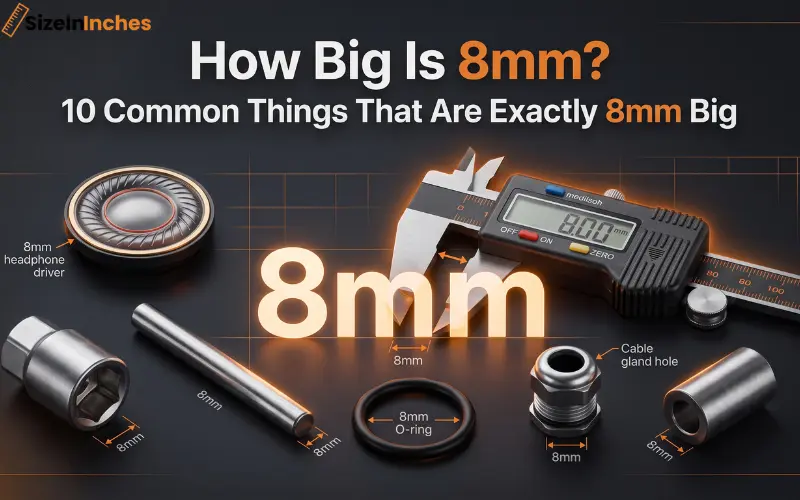
10 Real Objects That Are Exactly 8mm
Each object below has been verified against official manufacturing standards, ISO specifications, or industry measurements. No guessing. No approximations.
1. 8mm Headphone Driver
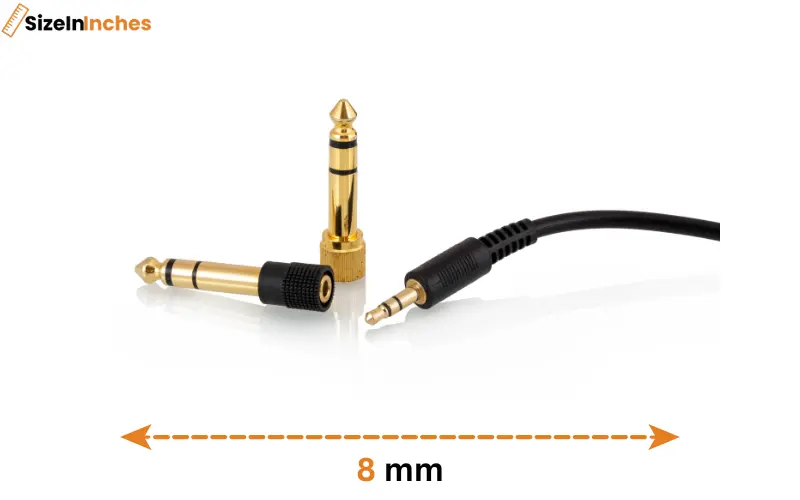
Exact size: 8mm diameter
Standard: Consumer audio driver specification
An 8mm headphone driver is the internal speaker unit used in many wired and wireless earbuds. Manufacturers design these drivers with an exact 8mm diameter to balance sound clarity and compact size.
You’ll find these inside everyday earbuds, especially budget and mid-range models. They are widely used because they deliver decent bass without making the earbuds bulky.
When you look closely at an exposed driver, it appears as a small circular disc. It’s noticeably bigger than tiny components but still small enough to fit comfortably in your ear.
This makes it an excellent real-world reference for understanding how big is 8mm in electronics.
2. 8mm Socket Wrench Size
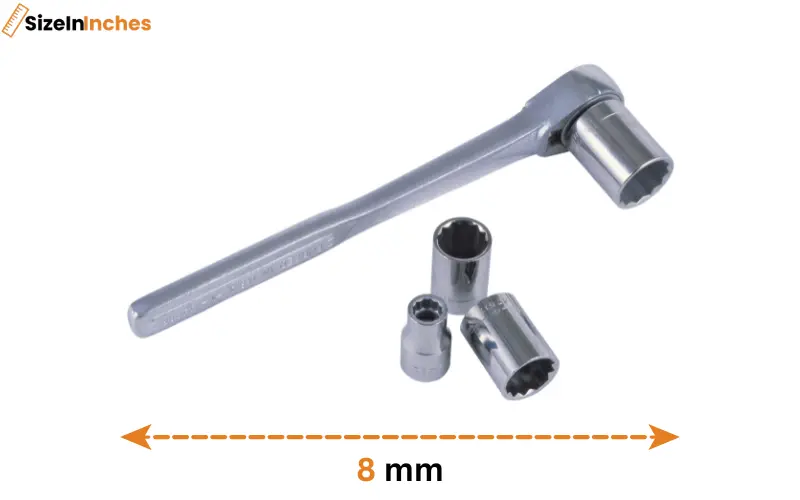
Exact size: 8mm internal width
Standard: Metric tool sizing standard
An 8mm socket wrench is designed to fit bolts and nuts that have an 8mm head. The internal opening is manufactured with precision to match exact metric specifications.
You’ll see this size in almost every household toolkit or mechanic’s set. It’s commonly used for assembling furniture, bicycles, and small machinery.
Looking into the socket, you’ll notice a compact hex-shaped opening. It’s small, but clearly defined and easy to recognize.
This gives a practical sense of 8mm size when working with tools.
3. 8mm Metal Rod
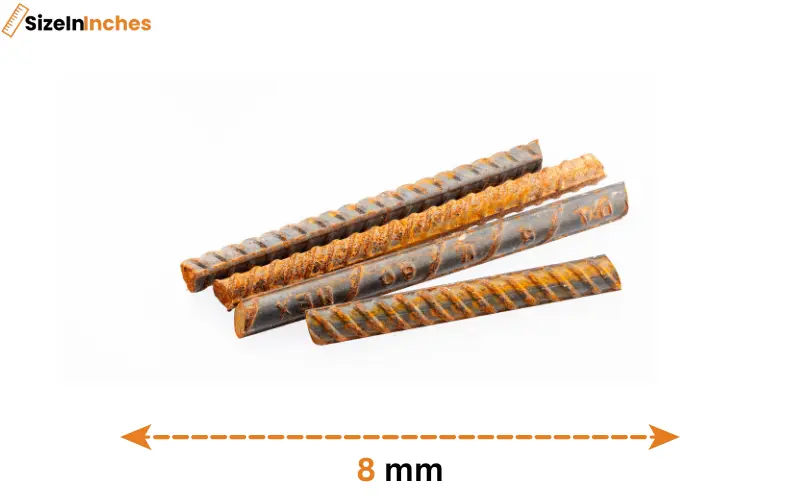
Exact size: 8mm diameter
Standard: DIN/ISO engineering standard
Metal rods are produced in fixed metric sizes, and 8mm is a standard diameter used in engineering and fabrication.
You’ll find these rods in construction projects, machine parts, and DIY frameworks. They are used where moderate strength and precision are needed.
Holding one feels similar to holding a thick pencil but slightly slimmer. It has a solid and balanced feel in your hand.
This makes it easy to visualize how long is 8mm across a cylindrical object.
4. 8mm Rubber O-Ring
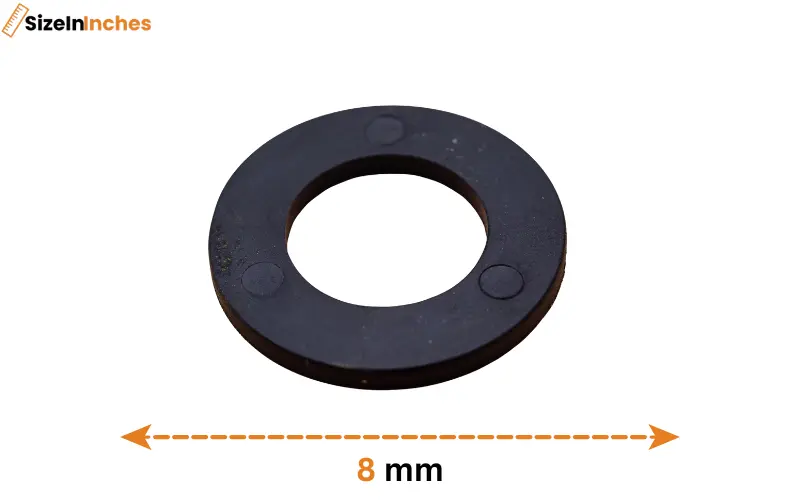
Exact size: 8mm inner diameter
Standard: ISO 3601 sealing standard
O-rings are sealing components used in mechanical systems, and an 8mm version refers to the exact inner diameter.
You’ll see these in plumbing, automotive systems, and small machinery. They prevent leaks and ensure tight seals.
When you hold one, it looks like a tiny rubber loop. It’s flexible but maintains its circular shape.
This is a useful example of what does 8mm look like in a flexible object.
5. 8mm Cable Gland Hole
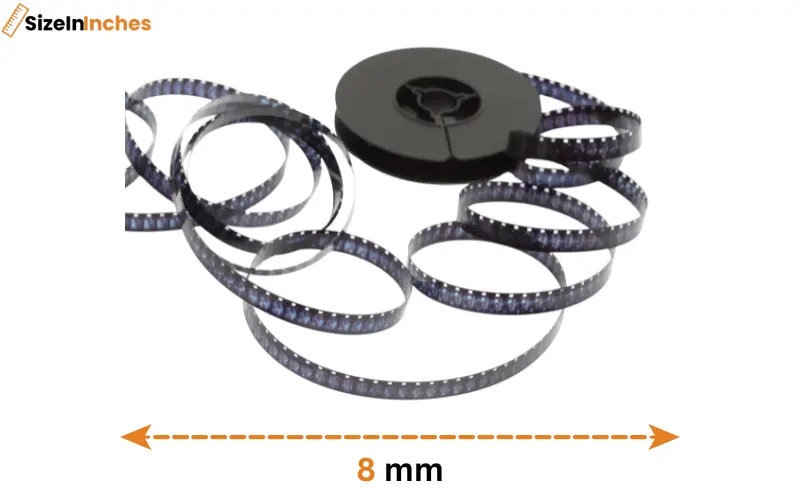
Exact size: 8mm diameter
Standard: Electrical installation sizing
Cable glands require precise hole sizes for installation, and 8mm is a standard drill size for certain fittings.
You’ll encounter this in electrical panels, control boxes, and wiring setups.
Looking at the hole size, it appears small but clearly visible. It’s large enough to pass a thin cable through.
This helps visualize 8mm in practical installation work.
6. 8mm Steel Spacer Sleeve
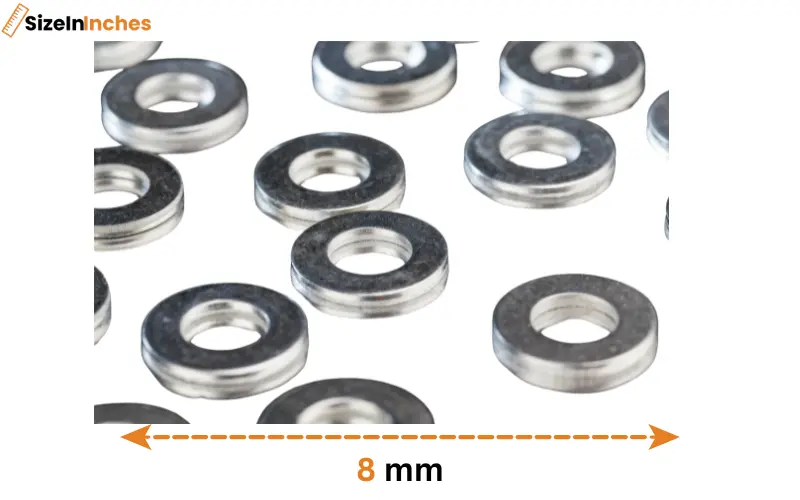
Exact size: 8mm inner diameter
Standard: DIN spacer standard
Spacer sleeves are used to maintain exact distances between mechanical parts, and 8mm is a common internal size.
You’ll find these in machinery, electronics, and mounting systems.
Holding one shows a short cylindrical piece with a hollow center. It’s compact but clearly engineered.
It demonstrates 8mm size in precise mechanical spacing.
7. 8mm Glass Laboratory Tube
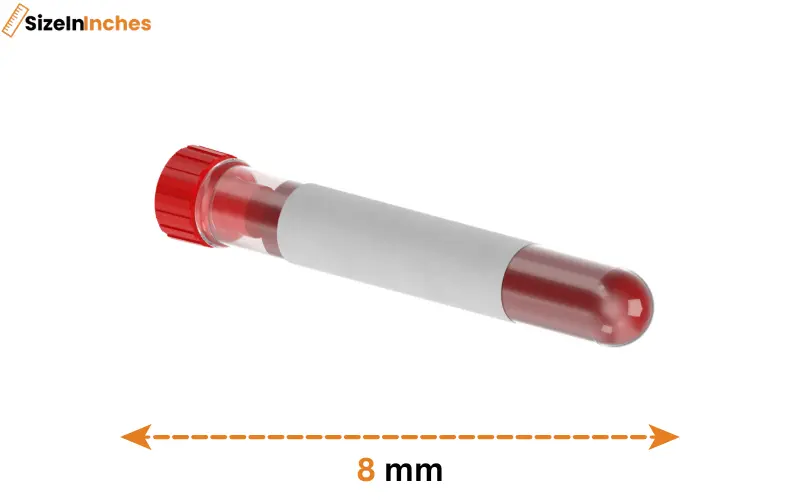
Exact size: 8mm outer diameter
Standard: Laboratory glassware sizing
Glass tubes used in laboratories are produced in standard diameters, including 8mm.
You’ll see these in science labs, experiments, and chemical setups.
When you look at one, it appears as a thin transparent cylinder. It’s delicate but clearly defined.
This is a clean visual example of 8mm diameter.
8. 8mm Bicycle Brake Cable Housing
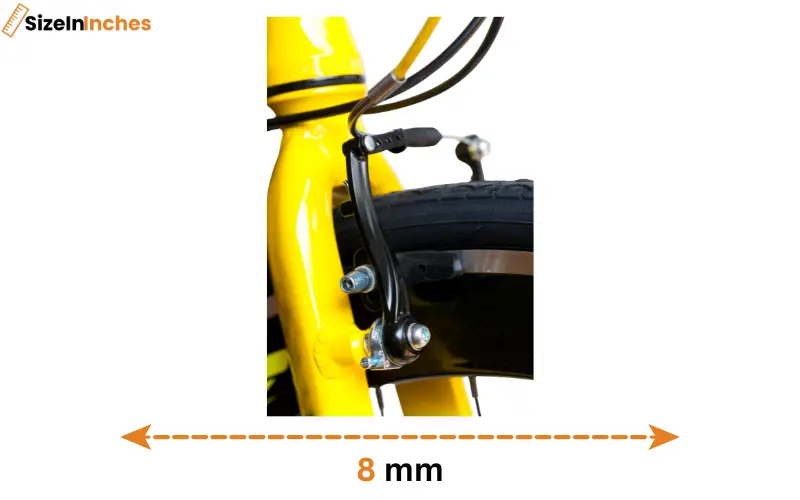
Exact size: 8mm outer diameter
Standard: Bicycle component sizing
Brake cable housings are manufactured with specific outer diameters, including 8mm variants.
You’ll see these on bicycles, especially in brake and gear systems.
Holding the cable shows a flexible tube that is slightly thicker than typical wires. It feels sturdy yet bendable.
This gives a real-world sense of 8mm size in everyday transport.
9. 8mm Domino Tile Thickness
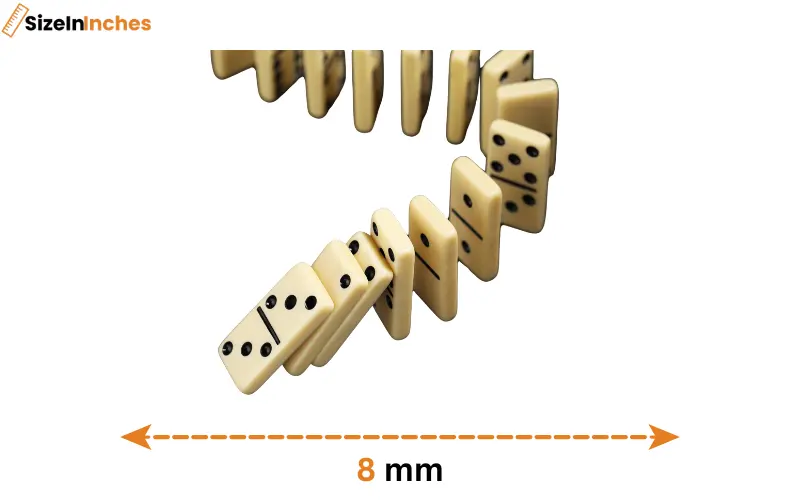
Exact size: 8mm thickness
Standard: Thin-set domino manufacturing spec
Certain domino sets are produced with a fixed thickness of 8mm, especially compact or travel versions.
You’ll find these in board game sets used at home or during travel.
Holding one feels like a slim rectangular tile. It’s thicker than a coin but still easy to stack.
This helps visualize 8mm as a vertical thickness.
10. 8mm Dowel Pin
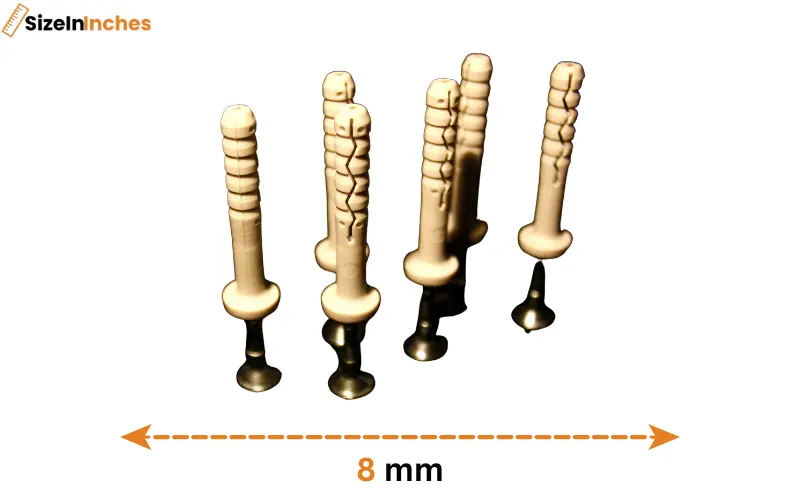
Exact size: 8mm diameter
Standard: ISO 8734
Dowel pins are precision components used for alignment in engineering, and 8mm is a standard size.
You’ll see these in machinery, furniture assembly, and woodworking.
Holding one shows a straight metal cylinder with a smooth finish. It feels compact and precise.
This reinforces how big is 8mm in real mechanical applications.
How 8mm Compares to Everyday Objects You Already Know
8mm becomes much easier to understand when you compare it to things you’ve already seen.
- 8mm vs 5mm: The difference is clearly visible. A 5mm bead looks small and subtle, while an 8mm bead feels fuller and more noticeable on the skin.
- 8mm vs 1cm (10mm): 8mm is just slightly smaller than 1cm, so it looks almost the same unless placed side by side.
- 8mm vs 1 inch (25.4mm): You would need a little more than three 8mm objects lined up to reach one inch.
This comparison helps your brain quickly understand where 8mm sits between small and medium sizes.
What Does 8mm Look Like in Real Life?
In your hand, 8mm is small but clearly visible. It’s not tiny like dust or grains—it’s something you can easily pick up and examine.
Place an 8mm bead on your palm. It takes up a noticeable spot without covering too much space. That’s why it’s commonly used in jewelry—it stands out without looking bulky.
On a flat surface like a table, 8mm looks like a small dot. But once you compare it to your fingertip, it suddenly feels more real and measurable.
Where You’ll Notice 8mm in Everyday Life
You may not think about it, but 8mm shows up in many places around you.
In jewelry, 8mm beads and pearls are one of the most popular sizes because they are balanced—not too small and not too large.
In tools, 8mm is a common size for bolts, drill bits, and hex keys. It’s widely used because it offers strength without being bulky.
In DIY work, 8mm holes, rods, and fittings are extremely common. Once you recognize the size, you’ll start noticing it everywhere.
How to Measure 8mm Without a Ruler (Accurate Methods)
Method 1 — Use Your Fingernail as a Guide
Look at the white tip of your pinky fingernail. Now imagine a width slightly larger than that. That extra bit brings you close to 8mm. This works because most adult nail tips fall between 5–7mm. Extending just beyond that gives a reliable estimate.
Method 2 — Compare With a Known 8mm Object
Use something like an 8mm bead, bolt, or drill bit. These are manufactured to exact size, making them perfect reference tools. Place the object next to what you’re measuring. This method gives one of the most accurate visual comparisons. It’s especially useful for jewelry or small parts.
Method 3 — Use a Ruler the Right Way
Place the ruler flat and locate the 0 mark. Count each small line—each one equals 1mm. Stop at the 8th mark. That point is exactly 8mm. This is the most precise way to measure and removes all guesswork.
Here are more size guides here:
FAQs
How big is 8mm in inches?
8mm equals exactly 0.315 inches, which is slightly less than one-third of an inch. If you place it next to a ruler, it sits just below the 1 cm mark. In real life, this size is similar to a medium bead or small button, making it clearly visible but still compact.
What does 8mm look like on your skin?
Place an 8mm bead or pearl on your palm. It will cover a noticeable area without spreading too wide across your skin. Compared to your pinky fingernail, it is slightly wider than the white tip, which makes it easy to recognize once you’ve seen it.
Is 8mm considered big or small?
8mm sits right in the middle between small and medium sizes. It’s larger than tiny precision parts like 3mm or 5mm components, but smaller than 10mm objects, which start to feel bulky. That’s why 8mm is often described as a “balanced” size in both tools and jewelry.
Is 8mm bigger than a grain of rice?
Yes, 8mm is clearly bigger than a grain of rice. Most rice grains measure between 4mm and 6mm in length, so an 8mm object stands out when placed next to one. This difference is easy to see even without measuring tools.
How long is 8mm on a ruler?
On a standard metric ruler, 8mm is the eighth small line after zero. Each line represents 1 millimeter, so you simply count up to eight. It sits just before the 1 centimeter mark, which is at 10mm.
How do I measure 8mm without a ruler?
You can estimate 8mm using your pinky fingernail by extending slightly beyond the white tip. Another reliable method is to compare it with a known 8mm object like a bead or bolt. These references are accurate because they are manufactured to exact size standards.
What jewelry size is 8mm?
In jewelry, 8mm is considered a medium bead or pearl size. It’s commonly used in bracelets and necklaces because it is visible without looking oversized. Many people prefer 8mm beads because they strike a balance between elegance and presence.
Where is 8mm commonly used in real life?
8mm is widely used in tools, hardware, and DIY work. You’ll find it in bolts, drill bits, and hex keys, as well as in jewelry like beads and earrings. Once you start recognizing it, you’ll notice that 8mm is one of the most common practical sizes in everyday objects.
Conclusion
The easiest way to understand how big is 8mm is by connecting it to real objects you can actually picture—like an 8mm bead, a pearl, or an M8 bolt. These are precise, standardized items that clearly show the size without any guesswork. Once you’ve seen or held one of these, 8mm stops feeling like a random number and becomes something you can instantly recognize.
This knowledge becomes useful more often than you think—whether you’re buying jewelry, choosing the right tool, or working on a DIY project. Instead of guessing and hoping for the right size, you’ll already know exactly what 8mm looks like. Save or bookmark this page so you always have a quick and reliable reference whenever you come across an 8mm size again.