Whether you’re shopping online, measuring something at home, working on a DIY project, or just trying to visualize a size mentioned in an article, 7 inches can feel oddly confusing. It’s not quite small, not quite large — and without a ruler in front of you, it’s hard to picture.
That’s exactly what this guide is here to solve.
In this in-depth article, you’ll discover 15+ common, real-life objects that are about 7 inches long, along with practical explanations, comparisons, and tips that make the measurement easy to understand and remember. By the end, you won’t just know what 7 inches looks like — you’ll feel confident visualizing it anywhere, anytime.
This guide is written for everyday people, not engineers or mathematicians. Simple language, real examples, and helpful insights — all in one place.
What Does 7 Inches Actually Mean?
Before jumping into examples, let’s ground ourselves in what 7 inches really represents.
Understanding 7 Inches in Simple Terms
-
7 inches equals 17.78 centimeters
-
It’s slightly longer than the width of most adult hands
-
It’s about the length of:
- Two credit cards placed end to end (with a little extra)
- A standard pencil minus the eraser
- A large smartphone
Seven inches often shows up in product descriptions, packaging dimensions, screen sizes, tools, and household items, which is why understanding it visually matters so much.
Why Knowing the Size of 7 Inches Is Useful
You might be wondering: Why does this even matter?
Here’s where knowing this measurement becomes surprisingly helpful:
- Shopping online and avoiding size disappointment
- Choosing the right tools or accessories
- DIY, crafting, or home improvement projects
- Understanding product specs clearly
- Explaining size to someone else without guessing
Once you can picture 7 inches clearly, you’ll make better decisions — faster.
15+ Common Things That Are About 7 Inches Long
Let’s get to the heart of the topic: real, everyday objects you’ve likely seen or used that measure close to 7 inches.
1. A Standard Pencil (Without Eraser)
Most wooden pencils are around 7 to 7.5 inches long when new. If you’ve ever held a fresh pencil, you already know what 7 inches feels like.
This makes pencils one of the easiest mental references.
2. A Large Smartphone
- Many modern smartphones measure 6.8 to 7.2 inches from top to bottom.
- If you’ve ever slid a phone into your pocket or held it in one hand, that length is very close to 7 inches.
3. A Dessert Plate
- Standard dessert or side plates are often 7 inches in diameter.
- So next time you’re setting a table, look at a smaller plate — that circular width gives you a solid idea of the measurement.
4. A Banana (Average Size)

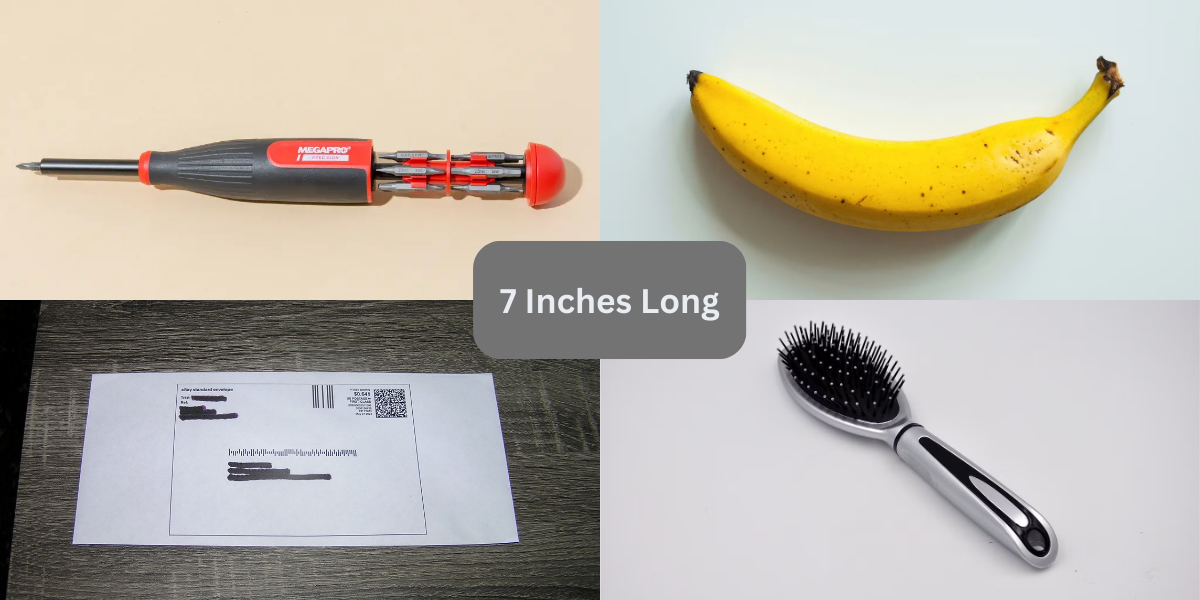
- While bananas vary, a typical medium banana is about 7 inches long.
- This example often surprises people because bananas are so familiar — yet rarely measured.
5. A Paperback Book’s Short Edge
- Many paperback novels are roughly 7 inches tall, especially mass-market editions.
- If you enjoy reading, you probably have a perfect 7-inch reference sitting on your shelf right now.
6. A TV Remote Control
- A common TV remote measures 6.5 to 7 inches long.
- Since remotes are designed for comfortable hand use, their length aligns well with this measurement.
7. A Dollar Bill (Almost)
- A U.S. dollar bill is 6.14 inches long, which is just slightly shorter than 7 inches.
- Add about the width of your thumb, and you’re there.
- This comparison is useful when you don’t have a ruler handy.
8. A Kitchen Spatula Blade
- Many spatula heads (not the handle) measure close to 7 inches in length.
- This helps visualize size in cooking and kitchen tool selection.
9. A Small Tablet Screen (Diagonal)
- Some compact tablets advertise 7-inch screens, measured diagonally.
- If you’ve ever used one, that screen size is a textbook example of the measurement.
10. A Standard Envelope (Long Side)

- Certain envelopes, especially invitation or greeting card styles, have a long edge around 7 inches.
- This is common in stationery and mailing supplies.
11. A Hairbrush Head

- The brushing surface of many hairbrushes measures about 7 inches, excluding the handle.
- This is another great everyday reference, especially for personal care items.
12. A Men’s Wallet (Open)
- When unfolded, many men’s wallets stretch close to 7 inches from end to end.
- It’s a subtle example but surprisingly accurate.
13. A Small Notebook
- Pocket and medium-sized notebooks often measure around 7 inches tall.
- If you journal or take notes, this is another practical size reference.
14. A Screwdriver Shaft
- The metal shaft of a standard screwdriver is frequently 6 to 7 inches long, depending on the model.
- This comes up often in tool descriptions and hardware shopping.
15. A Hand Span Plus a Bit
- An adult hand span (thumb to pinky spread) is typically 7 to 8 inches.
- So your own hand can act as a rough measuring tool in a pinch.
16. A Sub Sandwich (Half Size)
- Many deli sandwiches are cut into 7-inch halves.
- Next time you order lunch, take a closer look — you’re holding a perfect real-life measurement.
Common Misconceptions About 7 Inches
Even though 7 inches sounds straightforward, people often misunderstand it.
Misconception 1: “7 Inches Is Really Small”
Seven inches is large enough to:
- Fill most of your hand
- Be clearly visible from across a table
- Take up meaningful space in a bag or drawer
Misconception 2: “I Can Just Guess It”
- Most people overestimate or underestimate when guessing length.
- Without references, our brains are notoriously bad at judging measurements.
Misconception 3: “Screen Size Equals Physical Length”
- Screen size is measured diagonally, not straight across.
- A 7-inch screen doesn’t mean the device itself is 7 inches long — it’s usually larger.
How to Measure 7 Inches Without a Ruler
No measuring tape? No problem.
Here are practical ways to estimate 7 inches anywhere:
- Use your smartphone length as a guide
- Stack two credit cards and add a finger width
- Use your hand span
- Compare with a pencil or remote control
- Visualize a medium banana
These tricks are especially helpful when shopping or working on the go.
When Does 7 Inches Matter Most?
You’ll encounter this measurement more often than you think.
Common Situations
- Buying phone mounts or holders
- Choosing kitchen tools
- Measuring drawer space
- Crafting and DIY projects
- Product packaging dimensions
- Screen and device comparisons
Knowing what 7 inches looks like can prevent frustration, returns, and wasted money.
Tips for Remembering 7 Inches Easily
Here’s how to lock it into your memory:
- Associate it with one object you use daily (phone, remote, pencil)
- Practice visualizing it on different surfaces
- Compare it with your hand regularly
- Think “slightly longer than my hand”
Once you anchor it to real life, you’ll never forget it.
Frequently Asked Questions About 7 Inches
Is 7 inches considered big or small?
It’s a medium-length measurement — noticeable, practical, and versatile.
How many centimeters is 7 inches?
Seven inches equals 17.78 centimeters.
Can I measure 7 inches using my phone?
Yes. Most large smartphones are close to 7 inches tall, making them a reliable reference.
Is 7 inches the same for screens and objects?
No. Screen sizes are measured diagonally, while object length is measured straight.
Why do so many products use 7 inches?
Because it balances usability, portability, and comfort across many industries.
Is 7 inches longer than a hand?
For most adults, it’s slightly longer than the width of their palm.
What’s the fastest way to visualize 7 inches?
Picture a banana, a remote control, or a paperback book.
Final Thoughts
Measurements aren’t just numbers — they’re tools for making better decisions.
When you truly understand what 7 inches looks like in everyday life, you:
- Shop smarter
- Measure faster
- Communicate more clearly
- Avoid costly mistakes
From phones and pencils to plates and books, 7 inches is everywhere. Now, instead of guessing, you know.
Next time someone mentions a 7-inch object, you won’t hesitate — you’ll visualize it instantly and confidently.